
Access Restricted for EU Residents
You are attempting to access a website operated by an entity not regulated in the EU. Products and services on this website do not comply with EU laws or ESMA investor-protection standards.
As an EU resident, you cannot proceed to the offshore website.
Please continue on the EU-regulated website to ensure full regulatory protection.
Friday Jul 24 2026 03:26

26 min

To trade Ethereum and other altcoins from the UAE, the practical route for most active traders is CFDs: you speculate on ETH, XRP, or Dogecoin rising or falling — long or short, with no wallet to manage — through one regulated account. Demand here isn't theoretical, either: in Capital.com's 2024 country data, XRP and Dogecoin ranked among UAE traders' most-traded instruments — across all markets, not just crypto.
This guide covers how to trade Ethereum step by step, then extends the same framework to altcoin trading in XRP and DOGE — what drives each coin, and the risks stated plainly.
"Altcoin" simply means alternative coin — every cryptocurrency that isn't Bitcoin. That covers thousands of tokens, but for a trader the useful mental map has just a few categories: smart-contract platforms like Ethereum, whose tokens power entire application ecosystems; payment and settlement coins like XRP, built to move value quickly; meme coins like Dogecoin, whose value is almost purely social; and stablecoins, which peg to fiat currencies and aren't trading instruments in the same sense.
The differences from Bitcoin matter in practice. Bitcoin has one job — scarce digital value, capped at 21 million coins — and the deepest liquidity in crypto. Altcoins have more varied purposes, thinner liquidity, and sharper moves in both directions. When the crypto market rises, altcoins often rise further than BTC; when it falls, they usually fall harder. That extra amplitude is why active traders watch them — and why Bitcoin-sized positions are too big for altcoins.
One more Bitcoin habit carries over: BTC leads, and most altcoins take their broad direction from it before adding their own story. If you haven't traded the benchmark yet, start with how to trade Bitcoin CFDs — and for the full UAE picture on legality, regulation, and tax, begin with our pillar guide to crypto CFD trading in the UAE.
Want to see the difference in speed for yourself? Open a free demo account and watch ETH, XRP, and DOGE move side by side with virtual funds — the gap between them teaches faster than any paragraph.
Get a generous deposit bonus on your first trade with Markets.com. Hurry - claim yours today!

Ethereum, launched in 2015, is the second-largest cryptocurrency and the first of the smart-contract platforms — a network on which developers build applications, from decentralised finance to tokenised assets, paying fees in its native coin, ether (ETH). Strictly, "Ethereum" is the network and "ether" is the coin you trade, though the market uses the names interchangeably.
That design difference creates different drivers. ETH moves with the broad crypto tide — macro conditions, US rates, risk appetite — but it also has an economy of its own. Four ETH-specific forces are worth watching:
None of this yields price targets — anyone selling you an ETH prediction is selling something. What it yields is context: you'll know why ETH is moving, which events matter, and when to stand aside.
XRP is a different animal. It runs on its own network, the XRP Ledger, and was designed for fast, low-cost payments and settlement rather than smart contracts. It's closely associated with the company Ripple, which uses XRP in cross-border payment products — and that association wrote the most instructive case study in altcoin trading.
In December 2020, the US SEC charged Ripple with conducting an unregistered securities offering through its XRP sales, and the question of how XRP should be classified spent years moving through the US courts. A 2023 ruling drew a distinction between different types of XRP sales, which the market read as a partial win for Ripple, and the litigation subsequently wound down. The legal detail matters less to a trader than the market lesson: throughout that saga, XRP's sharpest moves — in both directions — clustered around legal and regulatory headlines rather than technology news.
That's the practical takeaway for XRP trading: this is a headline-sensitive instrument. Court dates, regulatory decisions, exchange listings and delistings, and payment-partnership news do the heavy lifting. If you hold a leveraged XRP position, you're implicitly holding it through whatever headline lands next — so know the calendar, or size as if you don't.
A local footnote: XRP's payments focus resonates in a region built on remittances — Capital.com's most-traded data suggests Gulf traders noticed long ago.
Dogecoin deserves the honest version, not the fun one. Created in 2013 as a literal joke — a payments coin branded with a Shiba Inu meme — DOGE has no supply cap, no meaningful application ecosystem, and a price driven almost entirely by social sentiment: viral posts, celebrity attention, and waves of retail momentum.
That makes dogecoin trading a pure sentiment instrument. With no fundamental story to anchor a thesis, moves can be enormous, abrupt, and unconnected to anything you could have researched. Rallies have appeared from nowhere and retraced just as fast. DOGE can be traded — strictly as a short-term momentum instrument — but it can't be invested in on fundamentals, because there aren't any.
If you trade it, three rules are non-negotiable. Size smaller than you would for Ethereum — materially smaller. Never hold a leveraged DOGE position on hope; sentiment that arrived without a reason can leave without one. And treat every parabolic spike as a warning, not an invitation — chasing vertical moves is crypto's most reliably punished habit, and meme coins produce the most of them. Some traders' best Dogecoin decision is not trading it at all.
Three coins, three different games. Here's the side-by-side view:
Feature | Ethereum (ETH) | XRP | Dogecoin (DOGE) |
|---|---|---|---|
What it is | Smart-contract platform; ether powers the network | Payments/settlement coin on the XRP Ledger | Meme coin, community-driven |
Main price drivers | Upgrades, staking flows, ecosystem activity, ETF flows, macro | Regulatory/legal headlines, partnership news, macro | Social sentiment, viral momentum |
Supply | No hard cap; issuance shaped by staking design | Large pre-created supply, released over time | No cap — new coins issued indefinitely |
Liquidity | Deepest of the altcoins | High among majors | Lower and momentum-dependent |
Volatility vs BTC | Higher | Higher, spiking on headlines | Highest of the three by far |
Trader's approach | Trend and event trading with the richest data | Event trading around scheduled headlines | Strict short-term momentum only, minimal size |
The volatility row is the discipline in disguise. Bitcoin is the calmest major — and it's already far more volatile than gold or indices. Each step along the altcoin curve demands a smaller position for the same account risk: smaller in ETH than BTC, smaller again in XRP, smaller still in DOGE, because the stop must sit wider to survive normal noise.
You could buy all three coins on a licensed exchange and manage three wallet balances. For active trading, an altcoin CFD (contract for difference) is usually the more practical instrument: an agreement to exchange the difference in a coin's price between opening and closing your position, without ever holding the coin.
In practice, an ethereum CFD — and its XRP and DOGE equivalents — changes four things. You can go short as easily as long, which matters enormously in a market famous for deep drawdowns. You get leverage, capped by regulators at the lowest tier of any asset class because of crypto's volatility — remember it magnifies losses exactly as it magnifies gains. You carry no wallet or custody risk — no seed phrases, no exchange-hack exposure, no withdrawal whitelists. And every coin sits inside one regulated multi-asset account, next to your gold and index positions, shar
ing the same charts and risk tools.
The trade-offs deserve equal billing: you can't spend, transfer, or stake what you don't own; overnight financing applies to positions held past rollover on standard accounts; and crypto CFDs aren't available to retail clients everywhere — the UK bans them for retail, and availability and coin lists vary by region and platform. If you're weighing ownership against trading properly, the full decision framework is in crypto CFDs vs buying crypto on an exchange.
Here's the path from zero to a first altcoin CFD trade, UAE edition:
Ready to run the sequence for real? Practise it end to end on a demo account, then explore crypto CFD trading live once your rules survive a full fortnight — including a weekend.
Trading altcoin CFDs lets you trade the price of Ethereum, XRP, Dogecoin and other coins beyond Bitcoin—without owning them, setting up a wallet, or using a crypto exchange. Here's how it works at Markets.com.
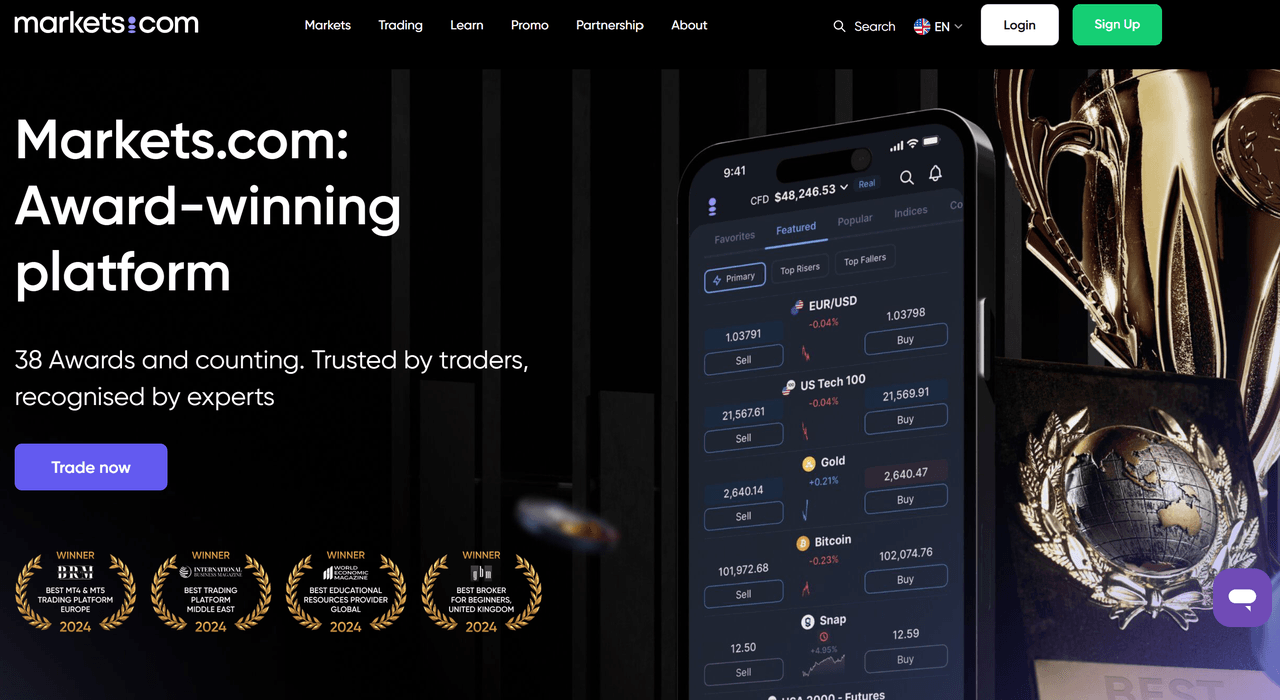
What you're actually trading
An altcoin CFD tracks a coin's price against the US dollar. You don't hold the token—you speculate on whether it rises or falls, going long or short either way. No wallet, no private keys, no exchange custody. Altcoins are higher-beta than Bitcoin: they often climb faster in a rally and fall harder in a sell-off, and thinner liquidity can mean wider spreads. They trade 24/7, including weekends, and because CFDs are leveraged, a smaller amount of capital controls a larger position—magnifying both gains and losses.
Step 1: Open an Account
Visit Markets.com or download the app, tap "Trade Now," and sign up with your email or a Google, Facebook, or Apple account.

Step 2: Verify Your Identity
Complete the KYC check: enter your country, personal details, and a few risk-assessment answers, then upload your proof of ID.
Tip: While your ID is under review, open the demo account to see how fast altcoins move and test a strategy risk-free.
Step 3: Fund Your Account
Deposit via card, bank transfer, e-wallet, Apple Pay, or Google Pay. Only fund what you're prepared to risk—crypto's swings and leverage cut both ways.

Step 4: Pick Your Coin
Each altcoin moves for its own reasons, so choose based on what you actually want exposure to:

Step 5: Place Your Trade
Search for the pair, set your position size, and choose Buy (long) if you expect the price to climb or Sell (short) if you expect it to fall.

Step 6: Manage Your Risk
Set a stop-loss and take-profit before you enter, and size altcoin positions smaller than you would for Bitcoin. Keep an eye on Bitcoin's direction too—capital tends to rotate into altcoins only when BTC is stable, and a sharp BTC drop usually hits altcoins harder.
Altcoin strategies are Bitcoin strategies with two extra instruments on the dashboard. The families — trend-following, breakout, and event trading — carry over directly from crypto trading strategies; what changes is the context you read them in.
Consider Mariam, a project manager in Dubai Marina who trades UAE evenings, when US hours overlap and crypto is busiest in GST terms. She trades ETH on trend and XRP only around scheduled headlines, sizes XRP at half her ETH size, and won't touch DOGE — a rule, not a mood. Her edge isn't prediction; it's selectivity and sizing.
The risks deserve their own plain paragraph. Everything that makes Bitcoin risky is amplified out here: double-digit daily moves are routine, drawdowns run deeper, liquidity thins faster in stress, and single headlines can reprice a coin in minutes — XRP's history proves it. Leverage turns those moves into account-threatening ones, thin weekend liquidity can slip stops, and no altcoin owes you a recovery to previous highs — many never get one.
Trade altcoins with money you can afford to lose entirely, a stop on every position, and sizes that let you be wrong many times and stay in the game. Most retail CFD accounts lose money; in altcoins, discipline isn't part of the edge — it's all of it.
Learning how to trade Ethereum is really learning a framework you can extend: understand what each coin is, identify its drivers, and let volatility set your position size. ETH rewards that work most — it has upgrades, staking flows, and a genuine ecosystem to analyse. XRP demands headline awareness above all. Dogecoin demands honesty: sentiment is the entire story, and small size or no trade are the only defensible approaches. For UAE traders — who already put XRP and DOGE among the country's most-traded instruments — the setting is favourable and the market never closes. Start with one coin on a demo account, and let your rules earn the second.
For active trading, an Ethereum CFD through a regulated broker is the practical route: you can go long or short on ETH with no wallet to manage, inside one multi-asset account. If you want to own and hold ether itself, a VARA- or ADGM-licensed exchange fits better.
Yes — with an ethereum CFD. A CFD tracks ETH's price, so you speculate on it rising or falling without owning coins, which means no wallet, seed phrase, or exchange-custody risk. The trade-off is you can't spend, transfer, or stake what you don't own.
Because its defining risks are regulatory rather than technological. XRP spent years at the centre of a US legal battle over how its sales should be classified, and its sharpest historical moves clustered around legal and regulatory headlines. XRP traders watch the news calendar the way index traders watch earnings.
No. Dogecoin is a meme coin driven almost entirely by social sentiment, with no supply cap and no fundamentals to analyse — the most volatile instrument most platforms list. Beginners should learn on Bitcoin or Ethereum first; if you ever trade DOGE, use minimal size and a stop on every position.
Yes, as a rule. Altcoins tend to rise further than Bitcoin in rallies and fall harder in sell-offs, with ETH the steadiest of the majors and meme coins like DOGE the wildest. That's why disciplined traders size altcoin positions smaller than BTC positions for the same account risk.
Yes — with CFDs. An altcoin CFD lets you open a sell position and aim to profit from a falling price, something buying coins on an exchange can't practically do. Shorting carries the same leverage and volatility risks as going long, so the same stop-loss discipline applies.
Capital.com, UAE traders dominate 2024 (XRP, Dogecoin among most-traded) — https://capital.com/en-eu/press/uae-traders-dominate-2024
Ethereum.org, The Merge — https://ethereum.org/en/roadmap/merge/
US SEC, SEC Charges Ripple and Two Executives with Conducting $1.3 Billion Unregistered Securities Offering (Dec 2020) — https://www.sec.gov/news/press-release/2020-338
Chainalysis, MENA Crypto Adoption 2025 — https://www.chainalysis.com/blog/middle-east-north-africa-crypto-adoption-2025/
Risk Warning: This article is provided for informational purposes only and does not constitute investment advice, investment research, or a recommendation to trade. The views expressed are those of the author and do not necessarily reflect the position of Markets.com. When considering shares, indices, forex (foreign exchange), and commodities for trading and price predictions, remember that trading CFDs involves a significant degree of risk and may not be suitable for all investors. Leveraged products can result in capital loss. Past performance is not indicative of future results. Before trading, ensure you fully understand the risks involved and consider your investment objectives and level of experience. Cryptocurrency CFD trading restrictions may apply depending on jurisdiction.
Latest
View all
Wednesday, 23 September 2026
10 min

Tuesday, 22 September 2026
35 min

Tuesday, 22 September 2026
25 min


 EN
EN





