
Access Restricted for EU Residents
You are attempting to access a website operated by an entity not regulated in the EU. Products and services on this website do not comply with EU laws or ESMA investor-protection standards.
As an EU resident, you cannot proceed to the offshore website.
Please continue on the EU-regulated website to ensure full regulatory protection.
Friday Jul 31 2026 03:43

24 min

A profit and loss (P&L) statement is a financial report that summarises revenues, costs, and expenses over a specific period — a quarter or a year — to show whether a business made or lost money. Also called an income statement, it's read from the top line (revenue) down to the famous bottom line (net profit or loss), and it's one of the three core financial statements alongside the balance sheet and cash flow statement.
This guide explains every component of a P&L statement with a worked example, the different formats, how to read one like an analyst — and, because most of our readers are traders, what P&L means in trading: realized versus unrealized profit, and why the best traders keep a P&L of their own.
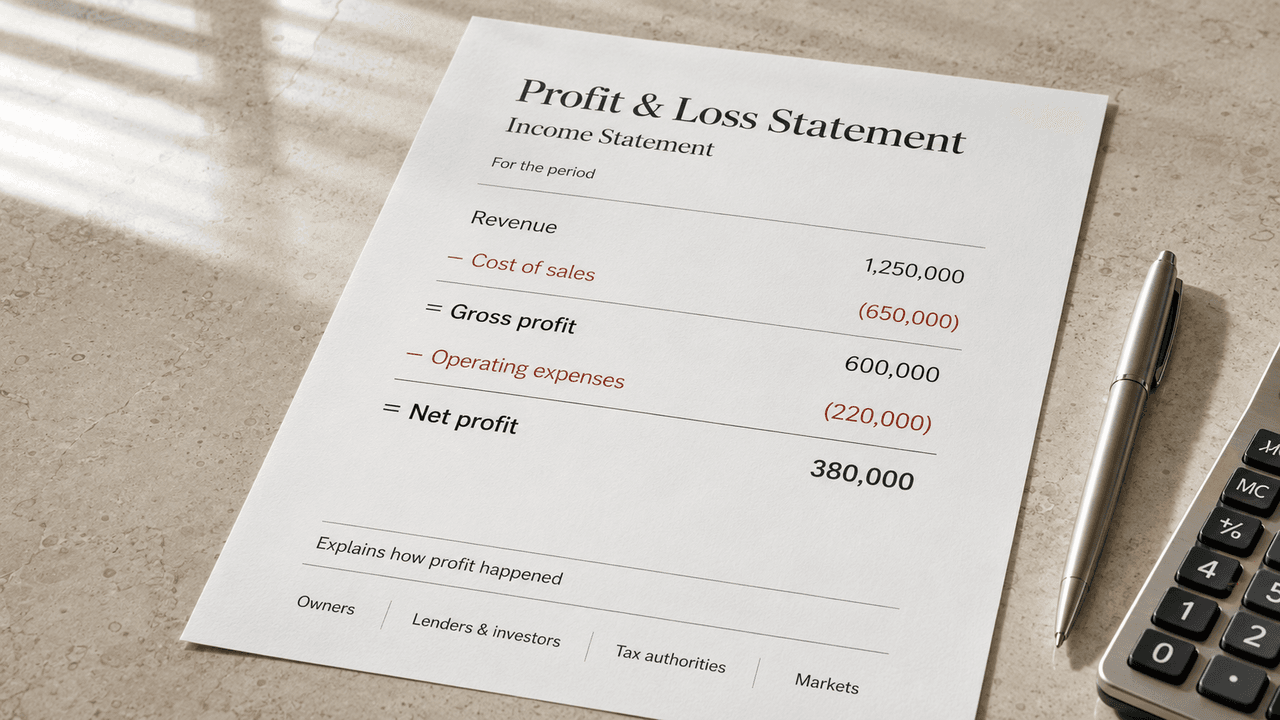
Think of the P&L as a business's scoreboard for a period of play. Where a bank balance only says what's left, the P&L explains how it happened: how much came in, what it cost to earn it, what it cost to run the operation, and what survived to the bottom line.
That explanatory power is why so many audiences rely on it. Owners use it to see what's driving or draining profit; lenders and investors read it to judge whether the business model works; tax authorities require the information behind it. Public companies publish one every quarter — and when traders speculate on a company's shares around "earnings season," the P&L (income statement) is the document the market is reacting to. Understanding it isn't just accounting literacy; it's market literacy.
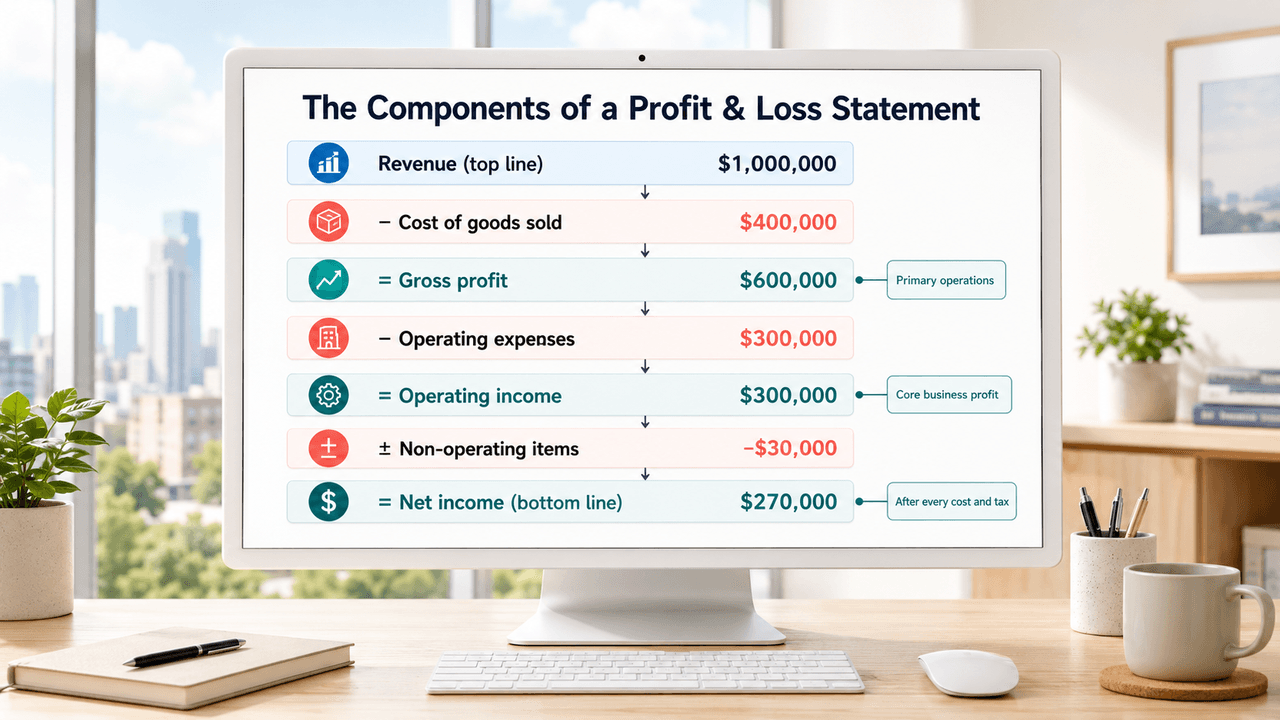
A standard P&L flows top to bottom through these lines:
Here's a simplified P&L for a fictional company over one quarter:
Line item | Amount |
|---|---|
Revenue | $500,000 |
Cost of goods sold | ($200,000) |
Gross profit | $300,000 |
Operating expenses (salaries, rent, marketing) | ($180,000) |
Operating income | $120,000 |
Interest expense | ($10,000) |
Pre-tax income | $110,000 |
Taxes | ($22,000) |
Net income | $88,000 |
Reading it tells a story in three acts: the product itself is healthy (a 60% gross margin), operations consume a manageable share (24% operating margin), and after finance costs and tax the business keeps 17.6 cents of every revenue dollar. Those three margins — gross, operating, net — are how analysts compress a P&L into judgement.
There are two standard formats, differing in how much story they tell:
A related choice is the accounting basis. Cash-basis P&Ls record money when it actually moves; accrual-basis P&Ls record revenue when earned and expenses when incurred, regardless of payment timing. Most serious businesses (and all public-company statements traders read) use accrual accounting, which matches effort to result — at the price of making "profit" and "cash in the bank" two different numbers.
Four habits turn a page of numbers into insight:
Statement | Question it answers | Time frame |
|---|---|---|
Profit & loss | Did we make money? | Over a period |
Balance sheet | What do we own and owe? | At one moment |
Cash flow | Where did cash actually move? | Over a period |
The three interlock: the P&L's net income feeds the balance sheet's equity and opens the cash flow statement. Analysts read all three because each can look healthy, while another hides trouble — profitable companies with broken cash flow, asset-rich companies with collapsing margins.
For a small business — or, as we'll see, a serious trader — the steps are:
Most businesses prepare a P&L at least quarterly and annually; accounting software automates the mechanics, but the categorisation choices still shape what the statement can tell you.
For all its authority, the P&L has blind spots worth naming:
The same humility applies to a trader's P&L: last month's profitable statement describes last month's market. It validates a process, not a future — which is exactly the mindset the risk warnings keep asking for.
For traders, "P&L" carries a second, daily meaning — and it's where this topic gets personal.
Position P&L. Every open CFD position has a live profit or loss: the price move since entry, times position size, minus costs (the spread, any commission, and overnight swaps). Your platform shows it tick by tick.
Unrealized vs realized. While a position is open, its P&L is unrealized (floating) — it exists on screen and moves with the market; it also feeds your equity and therefore your margin level, which is why a deep floating loss can trigger forced closures before you ever "take" it. The moment you close, the P&L becomes realized — actual money added to or subtracted from your balance. Traders who treat unrealized gains as spendable, or unrealized losses as not-yet-real, are keeping fictional books.
Your trading P&L statement. Here's the bridge back to accounting: the most effective habit in retail trading is running yourself like a small business. Your realized trades are revenue and losses; spreads, commissions, swaps, and data costs are your COGS and expenses; the period bottom line — monthly, honestly compiled — is your net income. A trading journal is exactly this: a P&L statement with commentary. It answers the question feelings can't: after all costs, over a real period, is this strategy profitable? Most retail CFD accounts lose money, and a personal P&L is the earliest, cheapest way to find out whether yours is among them — and why. You can build the habit risk-free by journalling demo account trades before a single dirham is at stake.
For UAE traders, moving from education to practical CFD trading begins with choosing an appropriate provider, understanding the underlying market and testing a written plan before committing capital.
Careful research and risk management remain necessary because CFDs are leveraged products and losses can occur even when a trade follows the written plan.
Opening a CFD account on Markets.com takes just a few minutes, whether on the website or mobile app. Follow these five steps to go from sign-up to your first trade.
Step 1: Sign Up for an Account
Visit Markets.com or download the app, click "Create Account," and register with your email or a Google/Facebook/Apple account.

Step 2: Verify Your Identity (KYC)
Complete the KYC check by entering your personal details and uploading proof of identity and address.
Step 3: Fund Your Account
Deposit via card, bank transfer, e-wallet, Apple Pay, or Google Pay. The minimum deposit is $100.

Step 4: Choose a Market and Place Your Trade
Select an asset like gold, forex, or shares. Choose Buy if you expect the price to rise, Sell if you expect it to fall, and set a stop-loss and take-profit before confirming.

Step 5: Manage and Close Your Positions
Monitor open trades, adjust risk settings as needed, and close positions manually or automatically when targets are hit.
New to Markets.com? Claim a generous deposit bonus on your first trade. Hurry—this offer is only available for a limited time.

A profit and loss statement is the scoreboard of any money-making activity: revenue at the top, costs and expenses subtracted in order, and the truth at the bottom line. Businesses read it through margins and trends alongside the balance sheet and cash flow statement; traders live a real-time version of it in every open position, split between unrealized and realized P&L. The deepest lesson transfers both ways — profit is only knowable after all costs, over a full period, honestly recorded. Whether you run a company or a trading account, the discipline of keeping and reading a P&L is what separates knowing from hoping.
It's a report showing money in versus money out over a period — revenue at the top, then costs, expenses, and taxes subtracted step by step, ending in net profit or loss. It answers one question: did this activity make money?
Yes — "profit and loss statement," "income statement," and "statement of operations" are different names for the same report. "P&L" is the everyday term; "income statement" is the formal accounting label you'll see in company filings.
The P&L measures performance over a period — did we profit? The balance sheet is a snapshot at one moment — what do we own and owe? Net income from the P&L flows into the balance sheet's equity, linking the two.
It's the floating profit or loss on an open position — the current price move times your position size, minus costs. It becomes realized only when you close the trade. Until then it moves with the market and affects your margin level.
Price change since entry × position size, minus trading costs: the spread, any commission, and overnight swap charges. A long position profits when price rises above entry by more than those costs; a short position, when it falls.
Log every trade as it closes, and review the compiled statement monthly — long enough to smooth out luck, short enough to catch problems early. Judge the strategy on the period's bottom line after all costs, never on individual wins.
Corporate Finance Institute, Profit and Loss Statement (P&L) — https://corporatefinanceinstitute.com/resources/accounting/profit-and-loss-statement-pl/
NetSuite, What Is a Profit and Loss (P&L) Statement? — https://www.netsuite.com/portal/resource/articles/accounting/profit-and-loss-statement.shtml
QuickBooks, What Is a Profit and Loss Statement? — https://quickbooks.intuit.com/r/bookkeeping/what-is-a-profit-and-loss-statement/
Cornell Law School LII, Profit and Loss Statement — https://www.law.cornell.edu/wex/profit_and_loss_statement
Risk Warning: This article is provided for informational purposes only and does not constitute investment advice, investment research, or a recommendation to trade. The views expressed are those of the author and do not necessarily reflect the position of Markets.com. When considering shares, indices, forex (foreign exchange), and commodities for trading and price predictions, remember that trading CFDs involves a significant degree of risk and may not be suitable for all investors. Leveraged products can result in capital loss. Past performance is not indicative of future results. Before trading, ensure you fully understand the risks involved and consider your investment objectives and level of experience. Cryptocurrency CFD trading restrictions may apply depending on jurisdiction.
Latest
View all
Wednesday, 23 September 2026
10 min

Tuesday, 22 September 2026
35 min

Tuesday, 22 September 2026
25 min


 EN
EN





