
Access Restricted for EU Residents
You are attempting to access a website operated by an entity not regulated in the EU. Products and services on this website do not comply with EU laws or ESMA investor-protection standards.
As an EU resident, you cannot proceed to the offshore website.
Please continue on the EU-regulated website to ensure full regulatory protection.
Wednesday Jul 29 2026 10:12

7 min

CME Group will launch single-stock futures on Monday, allowing investors to hedge or speculate on more than 50 of the largest U.S. companies.
Zhitong Finance APP has learned that investors will soon have another way to bet on the hottest stocks—from NVIDIA (NVDA.US) to SpaceX (SPCX.US)—without directly trading any shares. CME Group will launch single-stock futures on Monday, allowing investors to hedge or speculate on more than 50 of the largest U.S. companies. These contracts offer leverage without requiring investors to understand the complexities of options trading and will be cash-settled based on the closing prices of the underlying stocks.
The world’s largest derivatives exchange is betting on two trends—the rise of retail trading and the current market environment characterized by limited supply of in-demand IPO stocks—to drive adoption of single-stock futures. Although this instrument was first introduced 24 years ago and failed to gain widespread traction in the U.S. market at the time, CME believes the outcome could be different this time around.
Tim McCourt, Global Head of Equity Products, FX, and Alternative Investments at CME, said in a phone interview: “This has the potential to bring a significant number of new traders into our ecosystem.” He noted that the target clients include both retail investors and institutional investors such as asset managers. CME has already partnered with over 35 retail-facing intermediaries to help promote these futures products; for institutional investors, they will serve as a new risk management tool.
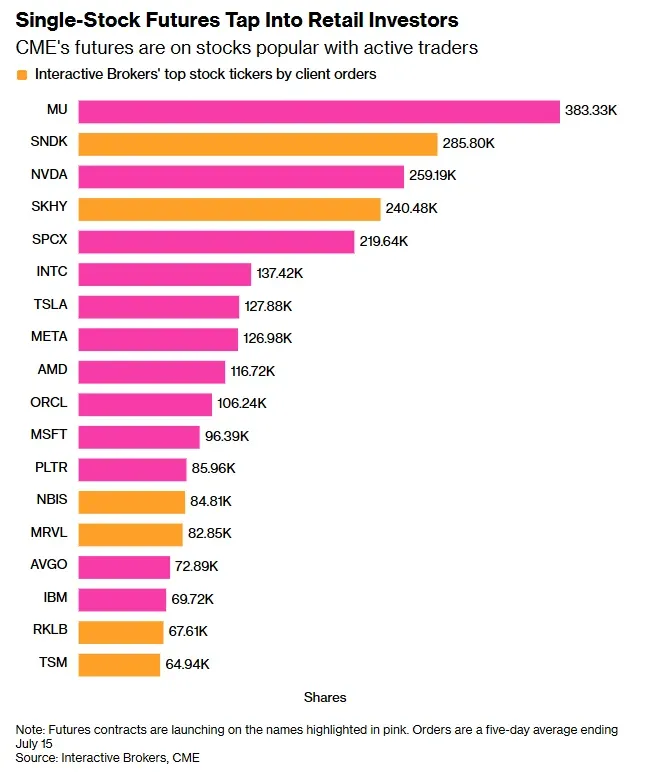
Single-stock futures target retail investors
Unlike options, single-stock futures provide leveraged exposure without requiring investors to grasp complex concepts such as the 'Greeks'—the set of parameters used in options trading to quantify financial risks, including core metrics like Delta and Gamma—which determine how changes in stock price, volatility, time, and interest rates affect derivative pricing.
One application of single-stock futures is to help investors establish long or short positions in companies whose shares are in limited supply. This situation arose recently during SpaceX’s initial public offering (IPO). Investors who were unable to secure allocations in the highly sought-after IPO may now use futures to gain more capital-efficient exposure to the company going forward.
Futures are simpler than options, which could make them more appealing to retail investors. Martin Franch, CEO of futures broker NinjaTrader, noted that retail traders tend to prefer financial instruments they understand. He stated: “There may be some investors who find all these Greeks and related concepts confusing and view futures as a simpler alternative.” He added, “Retail participation in the markets today is different, so this time around, single-stock futures could see significant changes.”
This launch comes at a sensitive time for CME. The Middle East conflict has benefited Intercontinental Exchange’s (ICE) Brent crude oil trading system, while CME’s West Texas Intermediate (WTI) crude oil futures business faces competitive pressure. Meanwhile, overseas derivatives platforms such as Hyperliquid Strategies Inc. are experiencing rapid growth in trading volume, and Kalshi Inc. and Polymarket are leading the emerging prediction markets space.
CME’s single-stock futures will be available for trading five days a week, 23 hours per day—significantly longer than the standard U.S. equity market hours of 9:30 a.m. to 4:00 p.m. Eastern Time. These quarterly futures contracts will come in two sizes: larger contracts covering 55 stocks, each representing 100 shares—similar in scale to standard options contracts—and 22 micro futures contracts, each representing 10 shares. The latter will include the 'Magnificent Seven' technology companies as well as 15 additional firms such as Micron Technology (MU.US), Pfizer (PFE.US), and Walmart (WMT.US).
Futures products are common in global equity index and commodity markets, but the development of single-stock futures in the United States has been highly turbulent. These contracts were banned for nearly two decades until a regulatory agreement signed in 2000 enabled regulators to establish a supervisory framework and approve trading rules in 2002. They eventually began trading later that year but never attracted sufficient market interest and were gradually phased out by 2020.
Shortly thereafter, regulators lowered the minimum capital requirements for investors trading single-stock futures, hoping to revitalize the market. CME’s launch of these products also requires approval from both the U.S. Securities and Exchange Commission (SEC) and the Commodity Futures Trading Commission (CFTC).
On July 22, during the company’s quarterly earnings conference call, CME Chairman and CEO Terry Duffy stated, 'The first time we launched these products, we failed spectacularly. But the world has changed since 2000.'
In markets like India, single-stock futures have achieved success. These instruments are used to establish leveraged directional positions, hedge equity portfolios, or capitalize on arbitrage opportunities. Single-stock futures also serve as a key foundational tool for arbitrage funds, which typically buy the underlying stock while simultaneously selling the futures contract to capture the price premium between the two.
In Europe, financial institutions use single-stock futures to enhance balance sheet efficiency, particularly during quarter-end and year-end regulatory reporting periods. Jeremy Cohen, Global Head at derivatives broker Stellar Securities, noted that these products are also employed to manage long positions, hedge short-position risk, and mitigate net dividend exposure.
However, like any financial instrument, the newly introduced contracts carry risks. Matt Cashman, head of investor education at the Options Clearing Corporation (OCC), pointed out that trading outside regular market hours—including the highly volatile minutes immediately following corporate earnings announcements—can result in extremely unstable market movements.
Additionally, there is the issue of commissions. Unlike stock or options trading—where many retail-focused platforms typically do not charge investors transaction fees but instead generate revenue by selling order flow to market makers—in the futures market, retail traders generally incur commission costs.
Stuart Kaiser, U.S. Equity Trading Strategy Head at Citigroup, believes the ultimate success of this product may hinge on the institutions driving its adoption. He remarked, 'Retail investors are already accustomed to using call options or leveraged ETFs to gain exposure with leverage. If futures are to enter this space, they will likely need discount brokers to promote the product and enable client access.'
Risk Warning: This article is provided for informational purposes only and does not constitute investment advice, investment research, or a recommendation to trade. The views expressed are those of the author and do not necessarily reflect the position of Markets.com. When considering shares, indices, forex (foreign exchange), and commodities for trading and price predictions, remember that trading CFDs involves a significant degree of risk and may not be suitable for all investors. Leveraged products can result in capital loss. Past performance is not indicative of future results. Before trading, ensure you fully understand the risks involved and consider your investment objectives and level of experience. Cryptocurrency CFD trading restrictions may apply depending on jurisdiction.
Latest
View all
Wednesday, 23 September 2026
6 min

Wednesday, 23 September 2026
9 min

Wednesday, 23 September 2026
6 min


 EN
EN





