
Access Restricted for EU Residents
You are attempting to access a website operated by an entity not regulated in the EU. Products and services on this website do not comply with EU laws or ESMA investor-protection standards.
As an EU resident, you cannot proceed to the offshore website.
Please continue on the EU-regulated website to ensure full regulatory protection.
Wednesday Aug 12 2026 03:24

7 min

CoreWeave shares rallied sharply after the artificial-intelligence cloud provider reported stronger-than-expected second-quarter results and disclosed another increase in contracted business.
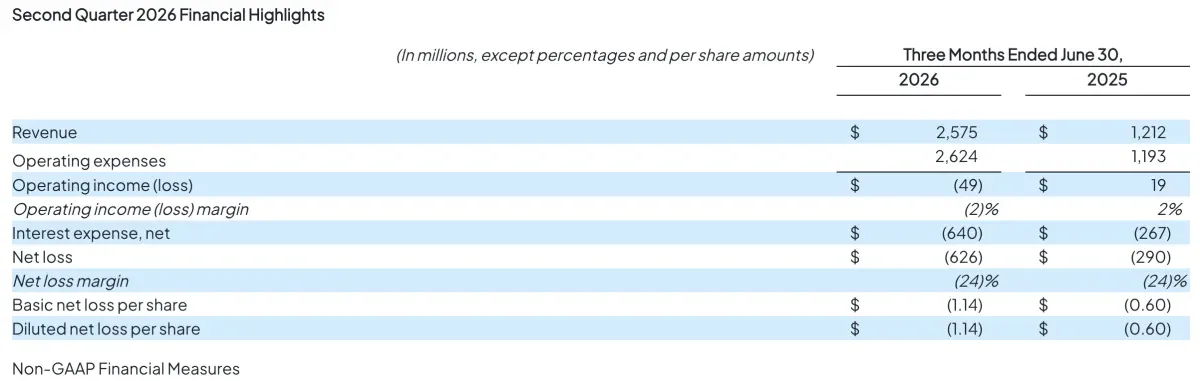
Revenue reached a record $2.575 billion in the three months ended June 30, up 112% from $1.212 billion a year earlier and slightly above analysts’ forecast of approximately $2.56 billion.
The company recorded a net loss of $626 million, or $1.14 per share, compared with a $290 million loss, or $0.60 per share, in the year-earlier quarter. Although the loss widened in absolute terms, the per-share result was better than the roughly $1.20 loss expected by analysts surveyed by FactSet.
CoreWeave stock jumped nearly 16% in extended trading following the release. The rally also lifted sentiment toward other AI infrastructure providers, reflecting investors’ continued confidence in demand for high-performance computing capacity.

The most closely watched figure in CoreWeave’s report was its revenue backlog, which rose to approximately $104 billion as of June 30, up from $99.4 billion at the end of the first quarter.
The backlog includes remaining contractual performance obligations and other committed amounts CoreWeave expects to recognize as revenue after meeting service availability and delivery requirements.
Crucially, the total excludes more than $25 billion in net new customer commitments added during the opening weeks of the third quarter. Including those commitments would put CoreWeave’s prospective contracted business near $130 billion, although the additional amount had not yet entered the company’s official backlog at the quarter’s end.
Management also said contracts signed during the second quarter are expected to produce margins five to 10 percentage points higher than contracts added over the preceding several quarters. The improvement suggests constrained AI computing supply is allowing CoreWeave to secure more favorable terms.
CEO Michael Intrator said customer demand is accelerating as AI adoption expands across enterprises and the company develops a broader technology platform.
CoreWeave added almost 500 megawatts of active power capacity during the quarter, bringing its operational capacity to approximately 1.5 gigawatts. Total contracted power reached about 3.7 gigawatts as the company expanded its portfolio of suppliers, data centers and powered land.
New customers included Bentley Systems, Caterpillar, Grammarly, Isomorphic Labs and Sunday Robotics. CoreWeave also expanded its relationships with existing customers such as Cognition, Databricks, Hudson River Trading, Rescale and Runway ML.
The customer additions show that demand is spreading beyond major AI laboratories and hyperscale cloud providers into industrial, financial-services and enterprise markets.
CoreWeave also completed what it described as the industry’s first deployment and validation of Nvidia’s Vera Rubin NVL72 system. The company reported new MLPerf training and inference records using open-source models running on Nvidia’s Grace Blackwell platform.
At the software level, CoreWeave is expanding beyond basic GPU rentals. Its newer services connect AI training, inference, data access, observability and agent deployment across multiple cloud environments.
The company’s managed inference operation reached a $100 million annualized revenue run rate during Q2, up from approximately $1 million in the previous quarter. This type of higher-value service could help CoreWeave diversify its revenue and improve margins over time.
CoreWeave’s rapid expansion continues to come with substantial financial costs.
Operating expenses more than doubled to $2.624 billion, resulting in an operating loss of $49 million. Net interest expense climbed to $640 million from $267 million a year earlier, reflecting the debt required to purchase chips and construct data centers.
Adjusted EBITDA doubled to $1.51 billion, but the corresponding margin fell to 59% from 62%. Adjusted operating income declined to $128 million from $200 million, while its margin contracted to 5% from 16%.
CoreWeave’s balance sheet showed approximately $35.1 billion of recourse and non-recourse debt at the end of June, compared with $5.52 billion in cash and cash equivalents.
The figures highlight the main question surrounding the company’s business model: its enormous backlog provides strong revenue visibility, but fulfilling those contracts requires similarly enormous upfront investment.
CoreWeave expects third-quarter revenue of $3.45 billion to $3.60 billion, above Wall Street’s estimate of roughly $3.4 billion.
The company also raised its full-year revenue guidance to between $12.4 billion and $13.2 billion, compared with its previous forecast of $12 billion to $13 billion.
However, projected capital expenditures were also increased. CoreWeave now expects to spend between $35 billion and $39 billion during 2026, up from its previous range of $31 billion to $35 billion. Second-quarter capital spending reached approximately $9.4 billion.
To finance its expansion, CoreWeave completed a $3.1 billion term loan and raised more than $10 billion through unsecured debt and convertible bonds, including its first euro-denominated bond. Jane Street also made a $1 billion strategic investment following an expansion of its commercial relationship with CoreWeave.
These transactions provide additional funding, but they also reinforce the company’s reliance on debt and external capital.
CoreWeave’s results provide evidence that the AI infrastructure investment cycle remains strong. The company says its near-term capacity is effectively sold out, while its backlog and newly secured commitments continue to grow.
The higher projected margins on recent contracts are also significant. They suggest demand is not being sustained solely through aggressive pricing and that limited access to advanced computing capacity may be strengthening CoreWeave’s bargaining position.
The post-earnings rally shows investors are currently prioritizing revenue growth, backlog visibility and improving operating leverage. Nevertheless, the company must demonstrate that its $104 billion backlog can ultimately generate sufficient cash flow to justify its growing debt and capital commitments.
Risk Warning: This article is provided for informational purposes only and does not constitute investment advice, investment research, or a recommendation to trade. The views expressed are those of the author and do not necessarily reflect the position of Markets.com. When considering shares, indices, forex (foreign exchange), and commodities for trading and price predictions, remember that trading CFDs involves a significant degree of risk and may not be suitable for all investors. Leveraged products can result in capital loss. Past performance is not indicative of future results. Before trading, ensure you fully understand the risks involved and consider your investment objectives and level of experience. Cryptocurrency CFD trading restrictions may apply depending on jurisdiction.
Latest
View all
Monday, 10 August 2026
6 min

Monday, 10 August 2026
5 min

Monday, 10 August 2026
5 min

Tuesday, 11 August 2026
Indices
Gold Price Today, August 12, 2026: XAU/USD Rises 0.5% Near $4,400 Ahead of US CPI

Tuesday, 11 August 2026
Indices
Oil Nears $90 as Fading U.S.-Iran Deal Hopes Renew Hormuz Supply Fears

Tuesday, 11 August 2026
Indices
NIO Stock News Today: Shares Slide as BlackRock Trims Stake Despite Record ES9 Demand

Tuesday, 11 August 2026
Indices
USD to JPY Exchange Rate May Have Peaked, Eurizon Sees Yen Strengthening to 125

Monday, 10 August 2026
Indices
Gold Price Today, August 11, 2026: Gold Rallies Above $4,430 as CPI Test Approaches

Monday, 10 August 2026
Indices
Microsoft Stock Jumps Nearly 30% as Analysts Raise Targets After Q4 Beat


 EN
EN





