
Access Restricted for EU Residents
You are attempting to access a website operated by an entity not regulated in the EU. Products and services on this website do not comply with EU laws or ESMA investor-protection standards.
As an EU resident, you cannot proceed to the offshore website.
Please continue on the EU-regulated website to ensure full regulatory protection.
Friday Jul 10 2026 02:49

27 min

The best CFD broker for beginners in the UAE isn't the one promising the fastest profits — it's the one that's authorised to serve UAE residents, teaches you properly, gives you a free demo account, keeps its platform simple, and builds risk management into every trade. That's a different shortlist from an experienced scalper's, which is why beginner-specific criteria matter.
This guide ranks the 10 best CFD brokers for beginners in the UAE for 2026, then covers what to look for in a beginner trading platform, how to start step by step, and the mistakes that end most new traders' accounts — honestly.
Beginners need different criteria than experienced traders. Here's what we scored:
Details below are starting points, not guarantees — confirm everything against each provider's current UAE terms.
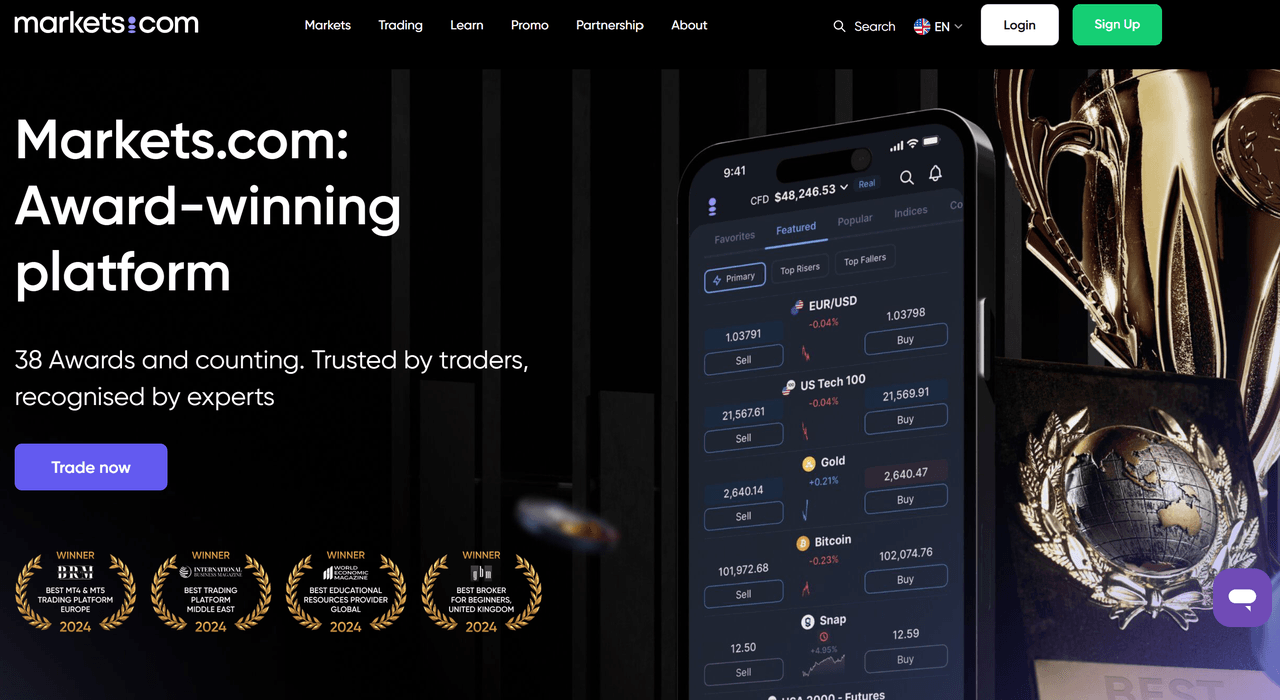
Markets.com takes the top spot for UAE beginners in 2026 because it's built around what a new trader needs first: a free demo account with virtual funds, a clean platform where stop loss and take profit sit on every order ticket, and education that explains leverage and margin before you use them. Practise on the demo as long as you like, then switch to live only when you're ready.
The platform keeps things simple without boxing you in later. One account covers forex, gold, indices, shares, crypto, ETF, and bond CFDs, with built-in decision support — real-time charts, market sentiment, analyst insights, and an economic calendar. In our editorial experience, new traders in the UAE disproportionately start with gold and major forex pairs, and having both alongside beginner-grade risk tools in one place shortens the learning curve more than any single feature.
Markets.com is regulated with segregated client funds and for beginners who need interest-free trading, and it offers swap-free account opening. Start on the demo, go live small, and let the risk tools do their job.
Pros
Cons
Ready to learn by doing? Open a free Markets.com demo account and place your first practice trade with virtual funds — no deposit needed.

eToro's signature CopyTrader lets beginners replicate experienced traders' positions — a distinctive way to see how others structure trades while you learn. The platform is among the most approachable in the industry, and its ADGM-linked UAE presence is frequently cited in regional comparisons.
The honest caveat: copying someone doesn't teach you risk management, and copied traders lose money too. Treat it as a learning aid alongside a demo, not a shortcut past the basics.
Pros
Cons

Plus500 runs one of the most deliberately simple proprietary platforms in the industry — a genuine advantage for a first-timer who wants to find a market, set a stop, and trade without professional-grade clutter. Risk tools are built in, including guaranteed stop-loss orders on eligible markets.
The simplicity is also the ceiling: charting and research are basic, there's no MetaTrader, and developing traders may outgrow it. For the learning phase, though, it's a long-standing easiest-platform pick.
Pros
Cons

XTB is frequently rated among the region's strongest brokers for education — a level-based academy with video courses, webinars, and quizzes, paired with the polished xStation platform. For a beginner who wants a course-like path rather than scattered articles, that structure is worth a lot.
Product range and account terms vary by region, so UAE specifics need checking — and xStation offers more depth than a first-timer strictly needs.
Pros
Cons

Capital.com pairs one of the cleanest mobile apps in the industry with in-app learning that surfaces lessons as you trade, and it ranks highly in UAE comparisons — a CMA licence is reported in recent coverage. For a mobile-first Gulf beginner, learning inside the app you trade on is a real advantage.
It's lighter on third-party platform support and deep research, and entity-specific terms need verifying.
Pros
Cons

AvaTrade is a multi-regulated veteran with clear beginner appeal: fixed-spread options that keep costs predictable while you learn, a clearly branded Islamic (swap-free) account, the approachable AvaTradeGO app, and solid education. Its regional presence and Arabic support are frequently cited in Gulf comparisons.
Spreads aren't the sharpest once you trade actively, and inactivity fees are a known gripe — relevant to beginners who pause after their demo phase.
Pros
Cons

IG pairs decades of operating history with one of the largest market ranges in the industry and a well-regarded education arm (IG Academy). Its DFSA-regulated Dubai presence is frequently cited — confirm the entity that would serve you. For a beginner who wants a broker they won't outgrow, it's the strongest case here.
The flip side: all that depth can overwhelm a first-timer. Start on the demo and ignore 90% of the platform until you need it.
Pros
Cons

XM has built its reputation on accessibility: very low minimum deposits and micro trading sizes that let beginners trade tiny positions while learning. Long-running webinars and platform tutorials add to the beginner case.
It's a MetaTrader-based broker, so the platform is older-school than app-first rivals — capable, but less hand-holding — and its UAE entity and terms need confirming.
Pros
Cons

easyMarkets targets nervous first-timers directly: fixed spreads, free guaranteed stop loss on its own platform, and dealCancellation, which can undo a losing trade within a set window for a fee. For beginners whose main fear is an early blow-up, that's a distinctive toolkit.
Those protections have costs baked in, and the range and research are narrower than the market leaders — reasonable trade-offs while learning, less so later.
Pros
Cons

HFM (formerly HotForex) rounds out the list for beginners who want to go live with the smallest possible stakes: it's known for low minimums and cent-style micro accounts where position sizes — and losses — stay tiny while you build habits. Education and demo access add to the starter case.
It's another MetaTrader-based broker, so expect a functional rather than beginner-styled interface, and check the UAE-relevant entity carefully — terms differ across its jurisdictions.
Pros
Cons
For the full market, see our pillar guide:
CFD trading is legal in the UAE through regulated providers and open to beginners — but suitability is a different question, and the straight answer is uncomfortable: most retail CFD accounts lose money. Broker disclosures across the industry typically show a majority of retail clients losing.
Here's why. A CFD (contract for difference) lets you speculate on whether a price — gold, EUR/USD, an index — will rise or fall, without owning the underlying asset. Leverage means a small deposit (margin) controls a much larger position, magnifying losses as efficiently as gains. A beginner using high leverage can lose their deposit in hours, not months.
That doesn't mean beginners can't trade CFDs — it means preparation is the point. The beginners who last practise on a demo for weeks, go live small, keep effective leverage low (5:1–10:1, not the maximum), and risk only 1–2% per trade. If that discipline sounds unappealing, better to discover it on a free demo than a funded account.
Six things, in this order:
Regulation authorisation. Mainland brokers answer to the CMA (formerly SCA), DIFC firms to the DFSA, and ADGM firms to the FSRA. Or other trusted global international licenses. Verify the licence of the exact entity that would hold your account — fail this test and nothing else matters.
A free demo account. Non-negotiable — it's where you learn order types and make your mistakes for free. Our CFD demo accounts UAE guide explains how to use one properly.
Education that starts at zero. Structured courses beat scattered articles. Leverage, margin, and stop losses should be explained before you meet them.
Platform simplicity with real risk tools. Stop loss and take profit on every ticket, clear margin display, negative balance protection. Trading mostly on your phone? Weigh our best trading apps UAE comparison too.
Low minimum deposit and honest costs. Start small; understand the spread (the buy/sell gap that is your cost per trade) and any inactivity fees.
Regional fit. A swap-free (Islamic) account option if you need interest-free trading, Arabic support, and the markets Gulf beginners actually start with — gold above all. If that's you, see gold trading for beginners UAE.
The safest route from zero to a first live trade:
Steps 1–3 cost nothing. Weeks of free practice is the cheapest trading education you'll ever get — start it today with a free demo account.
Opening a CFD account on Markets.com takes just a few minutes, whether on the website or mobile app. Follow these five steps to go from sign-up to your first trade.
Step 1: Sign Up for an Account
Visit Markets.com or download the app, click "Create Account," and register with your email or a Google/Facebook/Apple account.

Step 2: Verify Your Identity (KYC)
Complete the KYC check by entering your personal details and uploading proof of identity and address.
Step 3: Fund Your Account
Deposit via card, bank transfer, e-wallet, Apple Pay, or Google Pay. The minimum deposit is $100.

Step 4: Choose a Market and Place Your Trade
Select an asset like gold, forex, or shares. Choose Buy if you expect the price to rise, Sell if you expect it to fall, and set a stop-loss and take-profit before confirming.

Step 5: Manage and Close Your Positions
Monitor open trades, adjust risk settings as needed, and close positions manually or automatically when targets are hit.
New to Markets.com? Claim a generous deposit bonus on your first trade. Hurry—this offer is only available for a limited time.

The same handful of mistakes ends most new accounts. Knowing them in advance is half the defence:
There's no shortcut, and any broker or "guru" implying otherwise is a red flag. The boring habits — small size, hard stops, a written plan, a trade journal — separate the beginners still trading in a year from the ones who aren't.
The best CFD broker for beginners in the UAE is the one that's verifiably authorised, teaches you properly, hands you a free demo, and keeps risk tools one tap away — not the one shouting about maximum leverage. On those criteria, Markets.com leads our 2026 list for its simple platform, built-in risk management, and education, with eToro, Plus500, and XTB the strongest alternatives for copy trading, simplicity, and structured learning respectively — all subject to verifying current UAE terms. Start where every good trader started: open a free demo account, practise until it's boring, then go live small.
Markets.com is our top pick for UAE beginners in 2026 for its simple platform, built-in risk tools, education, and free demo account, subject to confirming its UAE authorisation and terms. eToro, Plus500, and XTB are strong alternatives depending on how you learn.
It's accessible but genuinely high-risk: most retail CFD accounts lose money, and leverage magnifies losses as fast as gains. Beginners who practise on a demo, keep leverage low, and risk 1–2% per trade give themselves a realistic chance.
Demo accounts are free, and several brokers on this list accept low minimum deposits. [VERIFY minimums] More important than the minimum: only fund what you can afford to lose, and size positions so no single trade risks more than 1–2% of your account.
Plus500 and Capital.com run two of the simplest interfaces, while Markets.com balances simplicity with risk tools you won't outgrow. The honest answer is personal — open two demo accounts and see which one you can use confidently within an hour.
Yes, through regulated providers. Mainland brokers answer to the CMA (formerly the SCA), DIFC firms to the DFSA, and ADGM firms to the FSRA. Always verify that the specific entity serving you is authorised before depositing.
Demo, without exception. A free demo account teaches the platform, order types, and risk tools with zero financial pressure. Go live only once your demo trading is consistent — and then start small.
ForexBrokers.com, Best CFD Brokers & Platforms — https://www.forexbrokers.com/guides/cfd-trading
BestBrokers, Best CFD Trading Brokers — https://www.bestbrokers.com/cfd-brokers/
BrokerChooser, Best Trading Platforms for Beginners (UAE FAQ) — https://brokerchooser.com/education/UAE-traders-FAQ/best-trading-platforms-for-beginners
IG, How to Choose a UAE Beginners Trading Platform — https://www.ig.com/ae/trading-need-to-knows/how-to-choose-uae-beginners-trading-platform
Risk Warning: This article is provided for informational purposes only and does not constitute investment advice, investment research, or a recommendation to trade. The views expressed are those of the author and do not necessarily reflect the position of Markets.com. When considering shares, indices, forex (foreign exchange), and commodities for trading and price predictions, remember that trading CFDs involves a significant degree of risk and may not be suitable for all investors. Leveraged products can result in capital loss. Past performance is not indicative of future results. Before trading, ensure you fully understand the risks involved and consider your investment objectives and level of experience. Cryptocurrency CFD trading restrictions may apply depending on jurisdiction.
Latest
View all
Thursday, 9 July 2026
25 min

Thursday, 9 July 2026
31 min

Thursday, 9 July 2026
27 min


 EN
EN





