
Access Restricted for EU Residents
You are attempting to access a website operated by an entity not regulated in the EU. Products and services on this website do not comply with EU laws or ESMA investor-protection standards.
As an EU resident, you cannot proceed to the offshore website.
Please continue on the EU-regulated website to ensure full regulatory protection.
Monday Sep 21 2026 08:15

31 min

Tariffs have returned to the centre of market attention as Donald Trump and Xi Jinping prepare to meet in Washington on September 24. Investors will be watching for an extension of the US–China trade truce, possible tariff reductions and developments involving rare-earth minerals, AI safety and advanced-chip controls. The outcome could affect technology, semiconductor, industrial, automotive and agricultural stocks.
So, how do tariffs affect the stock market? This guide explains how import taxes influence corporate earnings, inflation and major US indices, before examining the possible market implications of the Trump–Xi meeting.

A tariff is a tax imposed by a government on goods entering the country. If a US company imports components from China, the American importer generally pays the tariff to US Customs rather than China transferring money directly to the US government.
What happens next depends on the companies involved. The importer may absorb the additional cost, negotiate a lower price with its Chinese supplier or raise the price charged to customers. In practice, the burden may be shared among importers, foreign manufacturers, retailers and consumers.
Governments introduce tariffs for several reasons:
Tariffs should also be distinguished from export controls. A tariff makes an imported product more expensive, while an export control restricts whether a product can be sold abroad at all. US restrictions on advanced AI chips are therefore not conventional tariffs, but they can affect stocks through many of the same channels, including lost sales, supply-chain disruption and geopolitical uncertainty.
Quotas, sanctions and domestic subsidies can further alter trade without being tariffs. Investors consequently need to examine the exact policy rather than treating every US–China restriction as the same measure.
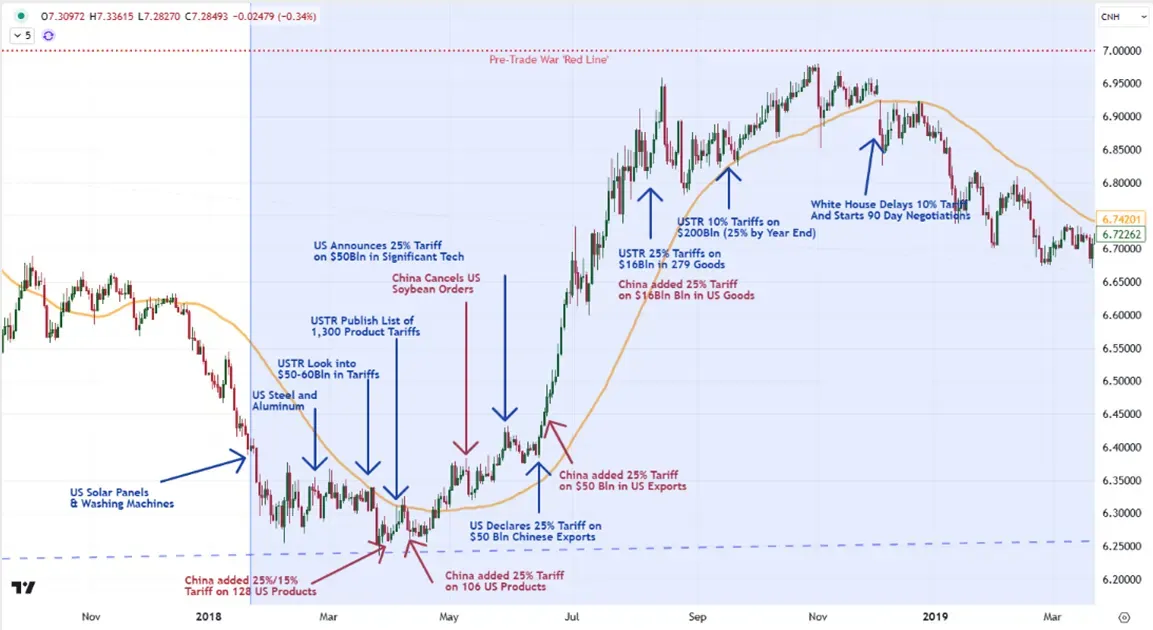
Source from: https://www.forex.com/
Tariffs typically increase short-term volatility and may pressure the broader stock market when they are extensive, unexpected or likely to provoke retaliation. Their longer-term effect depends on the tariff rate, products covered, policy duration and ability of businesses to adapt.
Tariffs do not change share prices directly. They change expectations for revenue, costs, inflation and economic growth, which investors then incorporate into stock valuations.
Tariff Channel | Effect on Companies | Possible Market Impact |
|---|---|---|
Higher input costs | Imported components and materials become more expensive | Lower margins and earnings forecasts |
Higher consumer prices | Businesses pass additional costs to customers | Weaker demand and higher inflation |
Retaliatory tariffs | Overseas markets become less accessible | Pressure on exporters and agricultural stocks |
Supply-chain disruption | Companies must locate new suppliers or production sites | Restructuring costs and delayed investment |
Domestic protection | Foreign products become less competitive | Potential gains for selected domestic producers |
Policy uncertainty | Businesses delay hiring and capital spending | Lower confidence and stock valuations |
Reshoring investment | Production moves closer to the US | Potential demand for construction and industrial equipment |
A company with strong pricing power may pass most of a tariff on to customers without losing substantial sales. A low-margin retailer may have less flexibility because even a modest price increase could send customers to a competitor.
Tariffs may also influence interest-rate expectations. If they raise consumer prices, the Federal Reserve may have less room to lower rates even as economic growth slows. That combination persistent inflation and weaker growth can be particularly difficult for stocks.
Markets do not always wait for the economic consequences to appear. An unexpected tariff announcement can cause investors to reduce earnings estimates immediately. Conversely, a tariff delay, exemption or trade agreement may produce a relief rally before businesses experience any measurable benefit.
Trade Major Indices with Markets.com
Get access to popular indices including the S&P 500, Nasdaq 100 and Dow Jones with Index CFDs. Eligible new clients can also unlock up to $5,000 in combined rewards. Explore Index CFD trading now.
Understanding how tariffs affect the U.S. stock market requires looking at the companies represented in each index. A business can be headquartered in the United States and still depend heavily on Chinese suppliers, overseas manufacturing or international customers.
Many S&P 500 companies operate globally. They may import materials and finished goods, manufacture products across several countries and generate significant revenue outside the United States.
Tariffs can therefore affect the index through higher costs and weaker international sales. Retaliatory measures can reduce access to overseas markets, while changes in the dollar may alter the reported value of foreign earnings.
Large companies may be better positioned to negotiate with suppliers or move production than smaller competitors. However, a complex global supply chain can also make relocation slow and expensive.
Technology and AI companies face a distinctive combination of trade risks. Semiconductor manufacturing, electronics assembly, networking hardware and data-centre equipment depend on specialised supply chains spread across the United States and Asia.
Tariffs on electronics or components can increase the cost of building servers, computers and data centres. Export controls can separately limit sales of advanced processors or related technology to Chinese customers.
Software companies may have less direct exposure to physical imports, but they are not immune. Lower corporate spending, higher interest rates or a decline in technology valuations can still affect their shares.
An agreement on AI safety could reduce geopolitical risk without removing existing chip restrictions. Investors should therefore distinguish between cooperation on AI incidents and commercial access to advanced technology.
The Dow contains several industrial, consumer and multinational companies. Its members can be affected by steel and aluminium prices, overseas demand and retaliatory tariffs.
A machinery or aerospace business may face both higher input costs and weaker export sales. Consumer brands may have to decide whether to absorb tariff expenses or raise prices in a market where households are already cautious.
Smaller US companies often earn a greater proportion of their revenue domestically, which can limit their exposure to foreign retaliation. That does not make them automatic tariff winners.
A small manufacturer may depend on imported parts but lack the negotiating power to secure lower supplier prices. Smaller companies may also have fewer resources for moving production and can be more sensitive to higher interest rates.
The important distinction is not simply domestic versus international. Supplier location, pricing power, debt, margins and customer exposure all matter.
Go Long or Short on Major Indices
Trade Index CFDs with Markets.com and take positions based on your view of rising or falling markets. Eligible new clients can unlock up to $5,000 in combined rewards. Trade indices today.

Tariff effects are rarely uniform across an entire sector. Two companies selling similar products can experience very different outcomes if one manufactures domestically and the other depends on imported components.
Sector | Possible Tariff Effect | Factors to Examine |
|---|---|---|
Technology and semiconductors | Component costs, export controls and supply uncertainty | China revenue, chip licences and production locations |
Automobiles | More expensive metals, batteries and imported parts | Domestic production and pricing power |
Retail and consumer goods | Higher merchandise costs | Gross margins, inventory and price sensitivity |
Industrials and aerospace | Material costs and weaker export demand | Government contracts and foreign order books |
Agriculture | Exposure to retaliatory tariffs | Dependence on Chinese and other foreign buyers |
Domestic metals | Protection from cheaper imports | Local demand and downstream cost increases |
Healthcare and services | Lower direct goods exposure | Imported equipment and broader economic conditions |
Energy and mining | Mixed trade and critical-mineral effects | Commodity prices, exports and domestic incentives |
Technology hardware, automakers, retailers and industrial exporters are often sensitive because they operate through international supply chains. Agriculture can be particularly vulnerable when trading partners target politically important US exports in retaliation.
Domestic steel or aluminium producers may initially benefit because tariffs make competing imports more expensive. Yet manufacturers purchasing those metals can face higher costs, potentially reducing overall demand.
A potentially more resilient company generally has strong pricing power, diversified suppliers, limited dependence on a single export market and sufficient financial flexibility to reorganise production. Investors should study these characteristics rather than assuming every company in a protected sector will benefit.
>> You may also like: How Do Interest Rates Affect Stock Market? September 2026 Fed Rate Hike
Trump and Xi are scheduled to meet in Washington on September 24, with trade, critical minerals, technology and Taiwan expected to feature prominently. The meeting is more likely to stabilise the existing relationship than create a complete reset, but even a limited agreement could affect market expectations.
Investors will be watching whether the two leaders extend the existing pause on major tariff escalation and rare-earth restrictions. Other questions include whether selected non-sensitive goods receive lower tariffs and whether China makes additional commitments to purchase US agricultural, energy or industrial products.
AI has also become a central topic. US officials have proposed a notification mechanism through which the two countries could communicate about serious AI-related national-security incidents. Recent talks have also covered a trade framework for non-sensitive goods, including selected consumer, agricultural, energy and medical products.
Three broad outcomes are possible.
An extension of the tariff truce, reduced duties on selected products or improved access to critical minerals could support market sentiment. Industrial exporters, agricultural businesses, automakers and multinational technology companies could benefit from lower policy uncertainty.
A formal AI-safety dialogue may also reduce the risk of accidental escalation. However, it would not automatically remove US controls on advanced semiconductor exports.
A more modest result could preserve existing trade arrangements while creating additional working groups. The two sides might announce progress on non-sensitive goods, rare-earth licences or AI-risk communication without changing the most important tariffs and export controls.
Markets could initially welcome the absence of escalation. Gains might prove limited, however, if the agreement contains few measurable commitments or implementation deadlines.
Stocks could face renewed volatility if the leaders fail to extend the truce, threaten additional tariffs or expand technology restrictions.
China could also use critical-mineral exports as leverage, while the United States could tighten rules covering semiconductors, AI models or infrastructure. Such an outcome would probably be most challenging for companies with concentrated Chinese suppliers or substantial sales exposure to China.
Geopolitical disagreements over Taiwan or other security issues could also disrupt economic negotiations. Investors should therefore evaluate the final policy details rather than reacting only to positive or negative summit language.
Tariffs can contribute to a major sell-off, but they rarely cause a stock market crash in isolation. The greatest risk emerges when broad trade restrictions combine with retaliation, weakening growth, persistent inflation and falling corporate earnings.
The severity of a market reaction depends on several factors:
History demonstrates the importance of surprise. Following the broad US tariff announcement on April 2, 2025, the S&P 500 fell 11% over two trading days. San Francisco Fed research found that markets appeared to price in persistent damage to corporate profits and broader economic activity.
That episode does not mean every tariff will cause an equivalent decline. A narrow tariff that investors already expect may produce little reaction. An unexpected economy-wide policy can have a much larger effect.
A potential 2026 market downturn would probably involve several pressures at once, such as earnings downgrades, restrictive interest rates, weaker employment, credit stress or a reassessment of AI valuations. Tariffs could amplify those risks without necessarily being the sole cause.
Investors can buy shares directly and hold them for the long term. Traders seeking shorter-term exposure to tariff announcements may instead consider contracts for difference.
A CFD tracks the price of an underlying share or index without transferring ownership of the asset. Traders can open a buy position if they expect the price to rise or a sell position if they anticipate a decline. This makes it possible to respond to both trade de-escalation and tariff escalation.
CFDs use margin, allowing traders to control a larger market position with less initial capital. The same feature magnifies losses as well as potential gains. Costs can include the spread and overnight financing, making CFDs generally more suitable for active speculation than long-term ownership.
Markets.com offers CFDs on major US indices and a range of individual shares. Traders can use live charts, technical indicators, price alerts, Trading Central, an economic calendar and trading calculators. Selected US stock CFDs are available for 24/7 trading, although hours and availability vary by instrument and jurisdiction.
Explore tariff-driven moves in US indices and shares with Markets.com.
Register with the appropriate Markets.com entity and complete the required identity, address and suitability checks.

Search for a major US index or a company affected by developments in trade, semiconductors, AI, industrials or consumer goods.

Review the company’s supplier locations, overseas revenue, margins, pricing power and management guidance. Determine whether it imports tariffed products or sells into markets that could retaliate.
For an index, examine which sectors have the largest weights and whether the tariff is likely to create a broad economic effect.
Select Buy if you expect the instrument to rise or Sell if you anticipate a decline. Remember that markets often price in expected policies before their official announcement.
A positive summit outcome can therefore produce a limited rally if traders had already anticipated an agreement. Similarly, shares may recover after negative news if the final policy is less severe than feared.
Use a trading calculator to estimate margin requirements, market exposure and possible profit or loss. Position size should reflect the amount of capital you can afford to risk.
Consider setting stop-loss and take-profit instructions before confirming the order. These tools can help define an exit plan, but orders may execute at a different price during gaps or extreme volatility.
Follow official tariff announcements, summit statements, corporate guidance and changes in available margin. Close the position manually or allow an existing risk-control order to execute.
CFDs are leveraged products and can cause losses to accumulate rapidly. Instrument availability, trading hours, leverage and other conditions differ by jurisdiction and Markets.com entity.
>> Read more: Fed Rate Hike Impact on Gold: What Happens When Interest Rates Rise or Fall?
The answer to how do tariffs affect the stock market depends on the scale, timing and design of the policy. Tariffs can raise costs, reduce margins, increase inflation and weaken consumer demand, although selected domestic producers may benefit from protection.
The Trump–Xi meeting could lower or increase uncertainty for technology, semiconductor, industrial and agricultural stocks. Investors should focus on supply chains, pricing power and overseas exposure rather than assuming every US company benefits from tariffs. Most importantly, markets react to the difference between the final policy and what investors had already expected.
Broad or unexpected tariffs often increase volatility and may pressure stocks by raising costs and weakening growth. However, selected domestic producers can benefit. The overall direction depends on exemptions, retaliation and prior market expectations.
Technology hardware, semiconductor, automotive, retail, industrial-export and agricultural stocks can be highly exposed. The effect on an individual company depends on its suppliers, manufacturing locations, foreign sales and ability to pass higher costs to customers.
Tariffs may protect selected industries and encourage domestic investment, but they can also raise prices, reduce profit margins and delay corporate spending. The net economic effect depends on their coverage, duration and whether other countries retaliate.
A crash would probably require several pressures at once, such as escalating trade conflict, falling earnings, persistent inflation, restrictive interest rates, credit stress or a sharp decline in highly valued AI stocks. Tariffs could amplify these conditions.
Tariffs can contribute to inflation by increasing the cost of imported goods and components. The final impact depends on whether importers absorb the cost, foreign suppliers lower prices or businesses pass the expense to consumers.
The importing company normally pays the tariff to the government imposing it. The economic burden may then be divided among the importer, foreign supplier and consumer through lower margins, negotiated prices or higher retail prices.
Removing tariffs can support affected stocks by lowering input costs and reducing uncertainty. The reaction may be modest if investors already expected the change or if other restrictions, such as export controls, remain in place.
Risk Warning: This article is provided for informational purposes only and does not constitute investment advice, investment research, or a recommendation to trade. The views expressed are those of the author and do not necessarily reflect the position of Markets.com. When considering shares, indices, forex (foreign exchange), and commodities for trading and price predictions, remember that trading CFDs involves a significant degree of risk and may not be suitable for all investors. Leveraged products can result in capital loss. Past performance is not indicative of future results. Before trading, ensure you fully understand the risks involved and consider your investment objectives and level of experience. Cryptocurrency CFD trading restrictions may apply depending on jurisdiction.
Latest
View all
Sunday, 20 September 2026
35 min

Sunday, 20 September 2026
31 min

Sunday, 20 September 2026
29 min


 EN
EN





