
Access Restricted for EU Residents
You are attempting to access a website operated by an entity not regulated in the EU. Products and services on this website do not comply with EU laws or ESMA investor-protection standards.
As an EU resident, you cannot proceed to the offshore website.
Please continue on the EU-regulated website to ensure full regulatory protection.
Friday Aug 21 2026 02:34

6 min
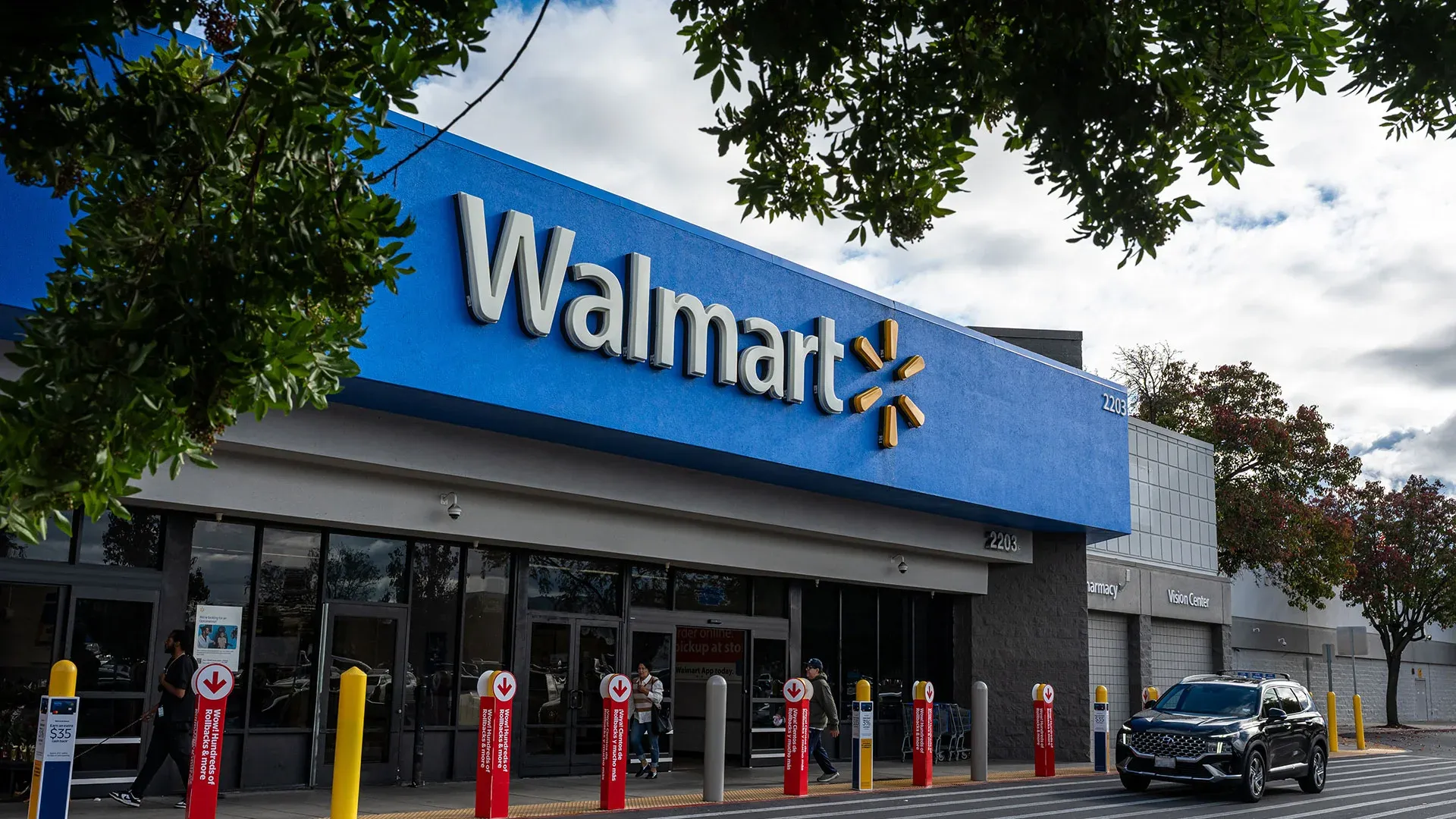
Walmart shares suffered their steepest decline in months after weaker US comparable sales and a cautious third-quarter outlook overshadowed better-than-expected quarterly earnings.
Walmart stock closed Thursday down 9.1% at $103.84, near its lowest level in nine months, after touching an intraday low of $102.92. The sell-off came despite the retailer beating Wall Street’s revenue and adjusted earnings estimates while raising parts of its full-year guidance.

For the second quarter of fiscal 2027, which ended July 31, Walmart reported total revenue of $187.94 billion, representing year-over-year growth of 5.9%. Analysts had expected approximately $186.77 billion.
Adjusted earnings increased 19% to $0.81 per share, comfortably exceeding the consensus estimate of roughly $0.74. Operating income rose 28.8% to $9.38 billion, while adjusted operating income increased 17.4% on a constant-currency basis.
Global e-commerce remained one of the company’s strongest growth engines, rising 23%. Walmart’s advertising business expanded 38%, and worldwide membership-fee revenue grew 17%. These higher-margin operations are helping the company reduce its dependence on traditional retail sales.
Nevertheless, investors concluded that the headline earnings figures overstated the strength of the underlying business. A large tariff refund boosted profitability, while the company’s most closely watched US sales indicator came in below expectations.
Walmart US comparable sales excluding fuel increased 2.6%, down sharply from 4.1% in the previous quarter and below Wall Street forecasts of approximately 3.5% to 3.8%.
That was the weakest comparable-sales performance in more than six years, raising concerns that elevated gasoline prices and persistent living-cost pressures are forcing consumers to reduce discretionary purchases.
The result requires some qualification. Walmart said new maximum-pricing rules affecting certain pharmacy products reduced comparable-sales growth by approximately 125 basis points. Excluding the health and wellness impact, US comparable sales would have grown about 3.4%, suggesting the slowdown was not entirely caused by weaker customer demand.
Even so, spending patterns revealed widening differences between income groups. Walmart continued gaining market share among households earning more than $100,000, while lower-income consumers became more selective and increasingly prioritized groceries and essential products.
The retailer implemented more than 11,000 price reductions during the quarter as customers searched for value. Executives also acknowledged that higher fuel costs were affecting shopping behavior, particularly among households with less disposable income.
Walmart received nearly $2.9 billion in refunds after a court ruling overturned tariffs imposed under emergency economic powers. The company said the refund produced a net benefit of approximately 750 basis points to adjusted operating-income growth.
Without that benefit, underlying operating-income growth would still have been near the upper end of Walmart’s previous 7% to 10% target. However, the refund was largely a one-time item, making it less useful when evaluating future earnings power.
Management plans to return much of the benefit to shoppers through lower prices rather than allowing it to flow entirely into profit. Price reductions are expected to become more visible during the third quarter, particularly across groceries and general merchandise.
The strategy could strengthen customer loyalty and market share, but it may limit near-term margin expansion. Investors had entered the earnings release expecting Walmart’s scale and tariff refund to produce a more substantial improvement in profitability.
Walmart’s digital operations offered a more encouraging picture. US e-commerce sales increased 24% and represented approximately 23% of Walmart US sales. Store-fulfilled delivery grew 40%, while marketplace sales expanded by more than 50%.
Walmart Connect, the company’s US advertising operation, grew 43% excluding Vizio. Advertising and marketplace services are strategically important because they can generate higher margins than selling groceries and household products.
Sam’s Club US also performed relatively well. Comparable sales excluding fuel rose 4.4%, e-commerce increased 26% and operating income reached $678 million, up 44.3%.
International net sales increased 12.8% to approximately $35.2 billion, or 7.9% in constant currency. Growth was supported by China, India and Canada, while improving e-commerce economics helped the international division’s operating profit.
Walmart expects third-quarter net sales to rise between 3% and 3.75% in constant currency. Adjusted earnings are forecast at $0.62 to $0.64 per share.
Both figures disappointed investors. Analysts had expected sales growth of around 4.9% and adjusted earnings near $0.67 per share. Walmart attributed part of the weaker sales forecast to the timing of Flipkart’s Big Billion Days promotion, which will move from the third quarter into the fourth quarter and create a sales headwind of more than 100 basis points.
For the full year, Walmart raised its constant-currency sales-growth forecast to between 4% and 5%, up from 3.5% to 4.5%. Adjusted earnings guidance increased to $2.80–$2.87 per share from $2.75–$2.85, while expected adjusted operating-income growth was lifted to 7%–8.5%.
The improved annual outlook was not enough to offset concerns about the immediate quarter, slowing US store sales and the temporary nature of the tariff-related profit boost.
Walmart is widely viewed as a barometer for American consumer spending. Its results suggest consumers are still purchasing necessities, but lower-income households are becoming more cautious as energy and living costs rise.
The stock’s 9.2% decline also demonstrates the risk created by elevated valuations. Walmart was trading at more than 35 times trailing earnings before the results, leaving little room for disappointing sales or conservative guidance.
Investors will now monitor whether price reductions can restore customer traffic without weakening margins. US comparable sales excluding pharmacy effects, e-commerce profitability, advertising growth and consumer behavior around the holiday season will determine whether the latest decline represents a temporary reset or the beginning of a more persistent slowdown.
Risk Warning: This article is provided for informational purposes only and does not constitute investment advice, investment research, or a recommendation to trade. The views expressed are those of the author and do not necessarily reflect the position of Markets.com. When considering shares, indices, forex (foreign exchange), and commodities for trading and price predictions, remember that trading CFDs involves a significant degree of risk and may not be suitable for all investors. Leveraged products can result in capital loss. Past performance is not indicative of future results. Before trading, ensure you fully understand the risks involved and consider your investment objectives and level of experience. Cryptocurrency CFD trading restrictions may apply depending on jurisdiction.
Latest
View all
Thursday, 20 August 2026
7 min

Thursday, 20 August 2026
6 min

Thursday, 20 August 2026
6 min

Thursday, 20 August 2026
Indices
Gold Price Today, August 21: Gold Holds Above $4,500 as Dollar Weakens

Thursday, 20 August 2026
Indices
Micron Stock Jumps 3.97% to $974.33 as $10 Billion AI Memory Lab Fuels Rebound

Thursday, 20 August 2026
Indices
SK Hynix Stock Outperforms KOSPI on Report of Potential Japan Memory Fab

Thursday, 20 August 2026
Indices
Alibaba Earnings Call: AI ARR Tops RMB49.5 Billion as Cloud Capex Targets Three-Year Payback

Thursday, 20 August 2026
Indices
Oil Price Today Nears $94 as Trump Escalates Economic Pressure on Iran

Thursday, 20 August 2026
Indices
Walmart Stock Crashes 9.2% Despite Earnings Beat as Weak Sales Expose Consumer Strain


 EN
EN





