
Access Restricted for EU Residents
You are attempting to access a website operated by an entity not regulated in the EU. Products and services on this website do not comply with EU laws or ESMA investor-protection standards.
As an EU resident, you cannot proceed to the offshore website.
Please continue on the EU-regulated website to ensure full regulatory protection.
Thursday Jul 30 2026 02:31

7 min
Key takeaways:
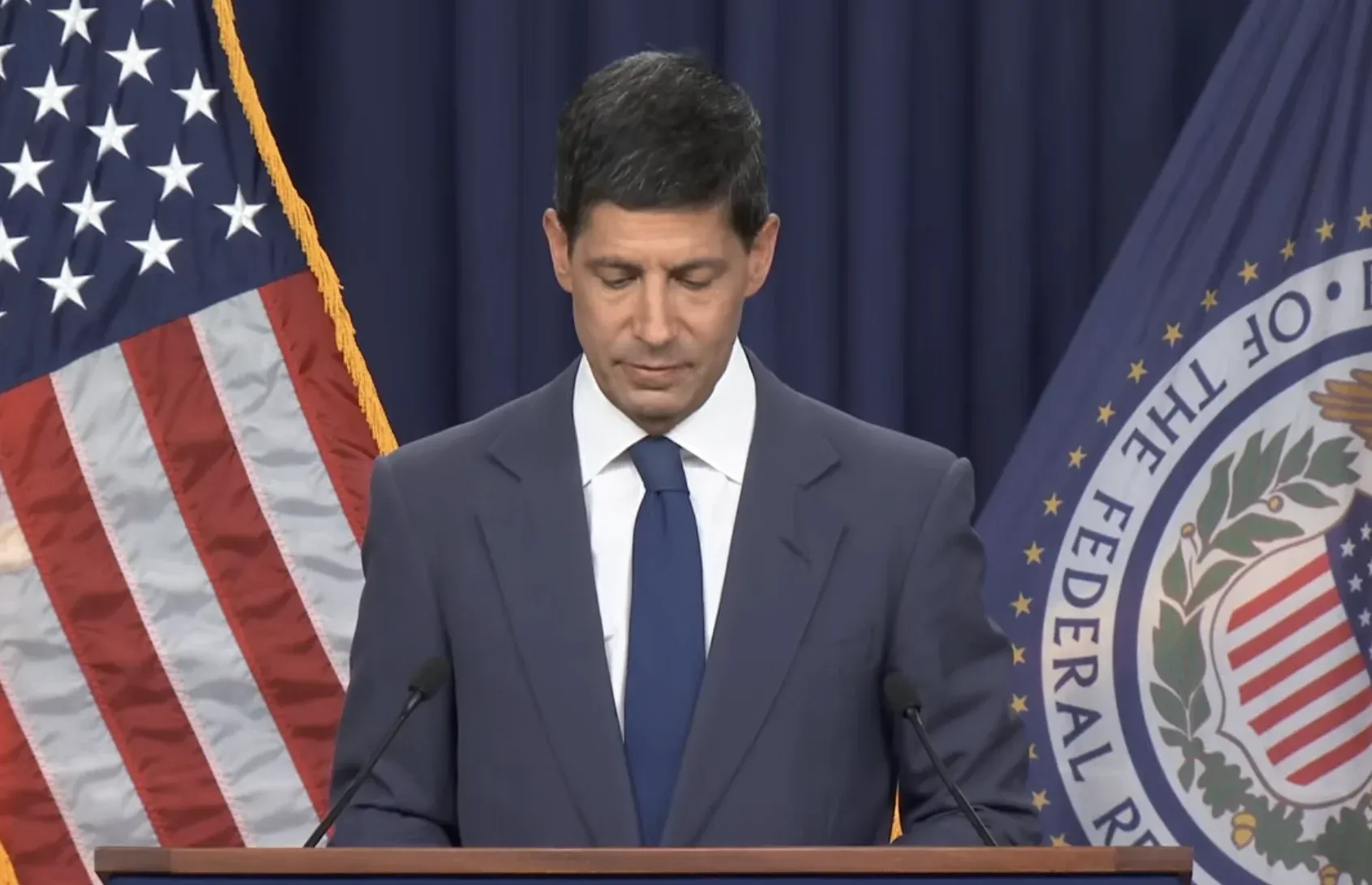
Federal Reserve Chair Kevin Warsh said the central bank’s 2% inflation target leaves no room for a softer or unofficial alternative, stressing that policymakers will not be diverted from their mandate by military conflicts, tariff changes or other external pressures. He said the surge in artificial intelligence investment is already lifting prices for memory chips and related infrastructure, while its longer-term effects on productivity, supply and inflation remain difficult to predict. Warsh also reinforced the Fed’s retreat from forward guidance, arguing that investors should respond to economic data rather than depend on signals from the central bank.
The Federal Reserve left its benchmark interest rate unchanged on Wednesday, but Warsh rejected the idea that policymakers had simply put monetary policy on hold.
The Federal Open Market Committee voted 9-3 to maintain the federal funds rate target range at 3.5%-3.75%. Cleveland Fed President Beth Hammack, Minneapolis Fed President Neel Kashkari and Dallas Fed President Lorie Logan dissented, preferring a 25-basis-point increase.
Speaking after the meeting, Warsh said the US economy continued to demonstrate resilience despite a series of recent shocks. Economic activity was expanding at a solid pace, business investment and productivity remained strong, employment growth was broadly keeping up with expansion in the workforce, and the unemployment rate had changed little.
Inflation, however, remained above the Fed’s 2% objective, partly because supply disruptions had raised prices in sectors including energy. Warsh reiterated that the central bank remained committed to restoring price stability.
Warsh sought to dispel speculation that the Fed might quietly accept inflation above its official target after more than five years of elevated price pressures.
He said there was no “soft” inflation target or higher implicit objective within the central bank. The only target was 2%, and FOMC members understood that commitment clearly.
At the same time, Warsh cautioned against interpreting one month of softer inflation as evidence that the problem had been resolved. More than five years of above-target inflation could not be reversed within nine weeks or through a single modest decline in prices, he said.
The Fed chair also kept further monetary tightening on the table. Although he did not provide a timetable or define a specific threshold for action, he indicated that higher interest rates would remain part of the policy response should inflation stay excessively high and fail to move sustainably toward 2%.
That message was reinforced by the three dissenting votes in favour of an immediate rate increase, highlighting growing concern within the committee that existing policy settings may not be restrictive enough to contain persistent inflation.
Warsh said the Fed would not retreat from its responsibilities under pressure from markets, political demands or changes in the external environment.
“The Fed will not waver,” he said, adding that the institution’s credibility depended on carrying out its duties and delivering on its commitments.
Policymakers are assessing a wide range of shocks that have affected the economy in recent years, including pandemic-related supply-chain disruptions, military conflicts, interruptions to energy supplies, substantial tariff increases and the rapid expansion of AI-related investment.
Warsh’s emphasis was not on judging those events themselves, but on determining how they feed through to output, employment and the broader price system. The Fed’s policy decisions, he indicated, would remain anchored to its price-stability and maximum-employment mandates rather than to the source of any particular shock.
Artificial intelligence emerged as one of the most important economic variables discussed at the meeting.
Warsh said spending on AI-related high-tech equipment and software had grown by nearly 20% over the latest four-quarter period. The investment boom was helping support manufacturing activity and laying the groundwork for future economic growth.
However, the expansion is also creating immediate price pressures. Strong demand for computing capacity is raising the cost of memory chips, logic chips and other infrastructure required to develop and operate AI systems.
The central question for the Fed is whether those increases represent isolated changes in relative prices or the early stages of a broader inflationary process. Policymakers are examining whether price gains in AI-related industries could spread to goods and services that have not been directly affected by the investment boom.
The longer-term consequences are even less certain. AI investment could eventually lift productivity, expand productive capacity and reduce inflationary pressure by allowing companies to produce more efficiently. Yet the infrastructure buildout required to achieve those gains may initially increase demand for chips, electricity, construction, equipment and skilled labour.
Warsh said the precise timing and scale of AI’s supply-side effects remained difficult to estimate. The technology therefore complicates the Fed’s assessment of the balance between demand and supply rather than automatically making monetary policy easier.
Warsh also reinforced a major change in the Fed’s communication strategy: a substantial reduction in forward guidance.
Instead of giving markets detailed signals about the likely direction of interest rates, the central bank wants investors to place greater weight on incoming economic information and the price signals produced by financial markets.
Warsh said both nominal and inflation-adjusted Treasury yields had risen materially across the yield curve during the 42 days between the June and July FOMC meetings. Some of those increases ranked around the highest decile of intermeeting moves recorded over the past two decades.
He suggested that the reduction in forward guidance may have contributed to the change. Without frequent intervention from the Fed, market participants had focused more directly on economic developments and adjusted asset prices in real time.
Warsh described the shift through a sporting analogy, saying investors were learning to “play the ball, not the referee.” In his view, markets should determine the direction and size of price movements based on their interpretation of the data rather than attempting to anticipate every signal from central-bank officials.
The Fed, meanwhile, wants to observe those reactions in a more direct and unfiltered form. Warsh argued that the central bank does not need to remain the centre of market attention during normal conditions, although he stressed that policymakers would still act whenever intervention became necessary.
The increase in Treasury yields also shaped Warsh’s interpretation of the latest policy decision.
He declined to describe the unchanged federal funds rate as a pause, calling the decision instead a rigorous reassessment of the economic outlook and the Fed’s objectives.
While the FOMC did not change its policy rate, financial markets had already produced a meaningful tightening in borrowing conditions. Nominal and real interest rates rose substantially between meetings, showing that financial conditions can shift even when the federal funds rate remains unchanged.
Warsh did not argue that higher bond yields removed the possibility of an eventual rate increase. Rather, he treated the market move as an important signal that needed to be considered alongside the incoming economic data.
The message from the Treasury market also appeared broadly consistent with the strength of the real economy. Output remained solid, capital expenditure and productivity were strong, and the labour market was stable. In Warsh’s assessment, rising market rates reflected at least some of the same economic resilience observed in the underlying data.
The Fed therefore chose to leave its benchmark rate unchanged while maintaining a clear tightening option. Warsh offered no preset path for the September meeting or beyond, leaving future decisions dependent on inflation, employment, financial conditions and the still-uncertain economic effects of the AI investment boom.
Risk Warning: This article is provided for informational purposes only and does not constitute investment advice, investment research, or a recommendation to trade. The views expressed are those of the author and do not necessarily reflect the position of Markets.com. When considering shares, indices, forex (foreign exchange), and commodities for trading and price predictions, remember that trading CFDs involves a significant degree of risk and may not be suitable for all investors. Leveraged products can result in capital loss. Past performance is not indicative of future results. Before trading, ensure you fully understand the risks involved and consider your investment objectives and level of experience. Cryptocurrency CFD trading restrictions may apply depending on jurisdiction.
Latest
View all
Wednesday, 29 July 2026
6 min

Wednesday, 29 July 2026
8 min

Wednesday, 29 July 2026
10 min

Wednesday, 29 July 2026
Indices
Gold Price Today, July 30: Gold Nears $4,100 After Fed Holds Rates Steady

Wednesday, 29 July 2026
Indices
Meta Stock Drops After Q2 Profit Falls 14% as Spending Concerns Grow
Wednesday, 29 July 2026
Indices
Warsh Reaffirms 2% Inflation Target, Defends Fed Independence and Flags AI-Driven Economic Shift

Wednesday, 29 July 2026
Indices
Qualcomm Stock Drops Over 4% as Memory Costs and Weak Outlook Eclipse Revenue Beat

Wednesday, 29 July 2026
Indices
Crypto News Today July 30: Market Holds at $2.19 Trillion as Stock Sell-Off Deepens

Wednesday, 29 July 2026
Indices
Samsung Q2 Operating Profit Surges 1,814% to Record as AI Memory Demand Accelerates

Wednesday, 29 July 2026
Indices
Microsoft Q4 FY2026 Revenue Hits $90 Billion, Adjusted EPS Reaches $4.74 as Azure Tops $100 Billion Annually

Wednesday, 29 July 2026
Indices
Robinhood Q2 2026 Revenue Rises 32% to $1.31 Billion as Diluted EPS Jumps 48% to $0.62


 EN
EN





