
Access Restricted for EU Residents
You are attempting to access a website operated by an entity not regulated in the EU. Products and services on this website do not comply with EU laws or ESMA investor-protection standards.
As an EU resident, you cannot proceed to the offshore website.
Please continue on the EU-regulated website to ensure full regulatory protection.
Wednesday Aug 5 2026 03:27

7 min

AMD shares fell sharply in extended trading after the chipmaker reported record second-quarter revenue and stronger-than-expected profit but issued a third-quarter outlook that failed to impress investors who had positioned for a larger AI-driven increase.
Second-quarter revenue rose 50% year over year and 13% sequentially to a record $11.54 billion, exceeding the approximately $11.3 billion Wall Street estimate. Adjusted earnings reached $1.66 per share, ahead of the $1.62 consensus forecast.
AMD projected third-quarter revenue of approximately $13 billion, plus or minus $300 million. Although the midpoint surpassed analysts’ roughly $12.5 billion estimate, the guidance did not meet some of the more aggressive expectations built into the stock after its substantial rally this year.
AMD’s Q2 revenue increased 50% to a record $11.54 billion, while adjusted earnings of $1.66 per share also exceeded expectations. Data center revenue surged 107% to $6.72 billion and accounted for 58% of total sales. AMD expects Q3 revenue of $12.7 billion to $13.3 billion, with the midpoint implying 41% annual growth, but investors had expected an even stronger forecast as AI accelerator deployments expand.
AMD reported GAAP net income of $2.30 billion, or $1.38 per diluted share, compared with $872 million and $0.54 per share a year earlier. GAAP operating income improved to $1.99 billion from a loss of $134 million in the previous-year quarter.
GAAP gross margin expanded by 14 percentage points to 54%, reflecting a more profitable product mix and the increasing contribution from data center processors and AI accelerators.
On an adjusted basis, net income reached $2.76 billion, up 253%, while operating income increased 245% to $3.09 billion. Adjusted gross margin was 56%, compared with 43% in the same quarter last year.
The distinction between the two accounting measures is important: the company’s reported 56% gross margin and $2.76 billion net income figures are non-GAAP results, while its GAAP gross margin and net income were 54% and $2.30 billion, respectively.
AMD expects third-quarter revenue to fall between $12.7 billion and $13.3 billion. The $13 billion midpoint would represent approximately 41% growth from a year earlier and 13% sequential growth.
Adjusted gross margin is expected to remain at approximately 56%.
The outlook was higher than Wall Street’s average revenue forecast of about $12.5 billion. However, it was not strong enough for investors who had anticipated a more dramatic acceleration as AMD ramps shipments of its latest Instinct accelerators and Helios rack-scale systems.
AMD shares closed Tuesday at $518.58 after gaining 7% during the regular session. Following the earnings release, the stock fell as much as nearly 9% in after-hours trading and remained down approximately 8.8% in subsequent trading.
The reaction reflected the expectations already embedded in AMD’s valuation. The shares had more than doubled in 2026 and had significantly outperformed the broader market, leaving the company with a higher threshold for delivering positive surprises.
The selloff also weighed on other semiconductor stocks, with Intel and Arm Holdings moving lower in extended trading.
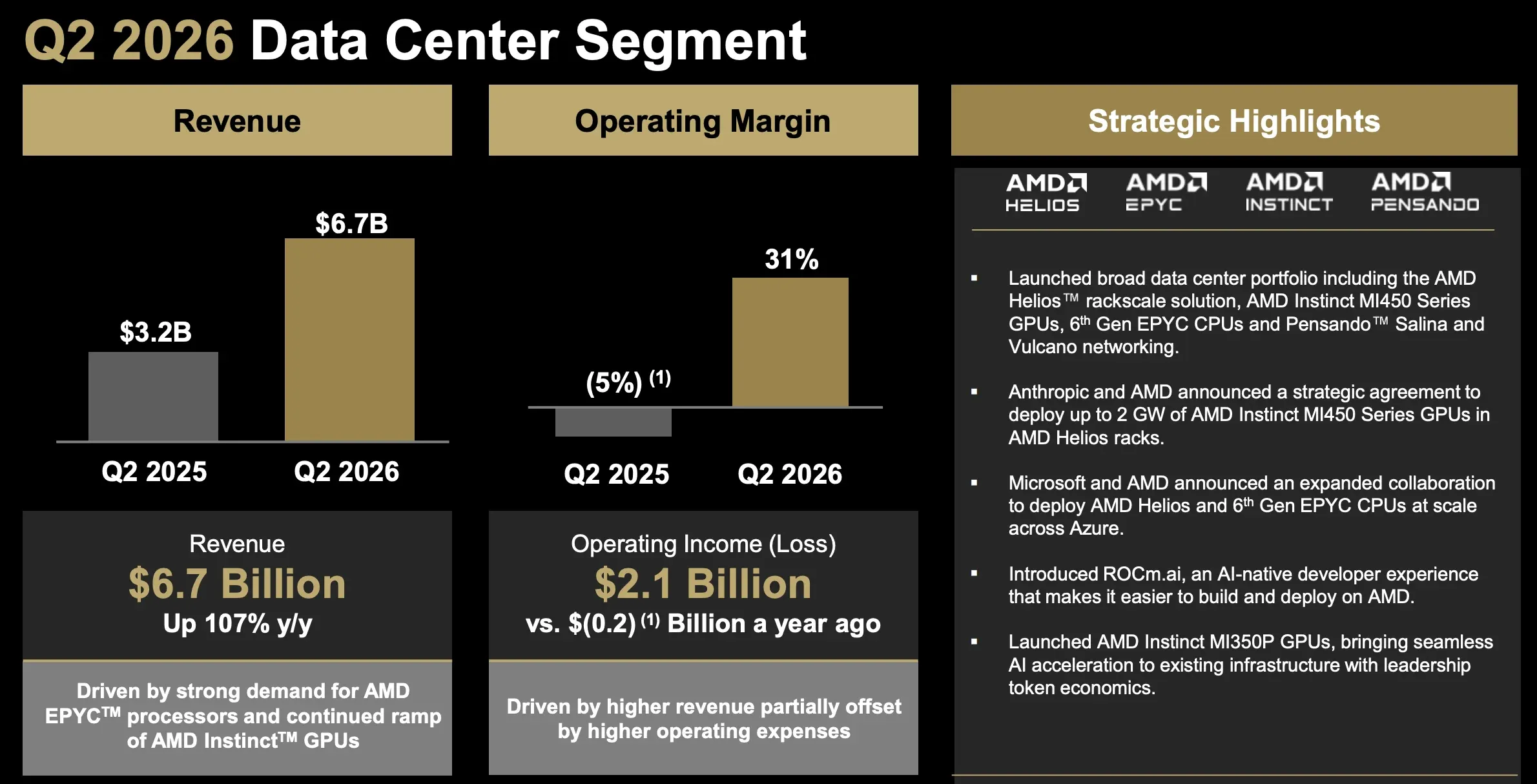
AMD’s data center division delivered the quarter’s strongest performance. Segment revenue reached $6.72 billion, up 107% from $3.24 billion a year earlier and accounting for 58% of companywide sales.
Demand for EPYC server processors and Instinct AI accelerators drove the increase. Data center operating income reached $2.10 billion, compared with a loss of $155 million in the same quarter last year.
AMD expects data center sales to accelerate further during the second half of 2026 as EPYC adoption increases, Instinct deployments expand and Helios systems begin contributing more significantly to revenue.
Large cloud providers continue to invest heavily in AI data centers, supporting demand for GPUs, CPUs, networking equipment, memory and other infrastructure. The spending cycle gives AMD an opportunity to capture additional market share, but also raises expectations for faster quarterly growth.
AMD is moving beyond selling individual processors toward offering complete AI infrastructure systems that combine accelerators, server CPUs, networking hardware and software.
The company recently introduced the Helios rack-scale platform, which integrates sixth-generation EPYC “Venice” processors, Instinct MI455X GPUs and Pensando networking. Each system connects 72 GPUs in a single scale-up domain and is designed for large AI training and inference workloads.
Helios is being deployed by AI laboratories and cloud providers including Anthropic, Meta, Microsoft, OpenAI and Oracle. AMD is preparing to begin deliveries near the end of the third quarter before increasing production during the fourth quarter and into 2027.
Under AMD’s strategic agreement with Anthropic, the AI company plans to deploy as much as 2GW of MI450-series GPUs in Helios systems. The first gigawatt is scheduled to begin deployment during the first half of 2027. AMD and Anthropic will also use Claude to optimize Instinct workloads and accelerate ROCm software development.
Microsoft is expanding its relationship with AMD by deploying Helios systems at scale on Azure for frontier-model inference. These agreements show that major customers are willing to introduce alternatives to Nvidia hardware into production environments.
Nvidia nevertheless retains a dominant position in AI accelerators, supported by its CUDA software ecosystem, systems portfolio and longstanding developer relationships. AMD must prove that Helios can compete not only on performance and cost but also on software maturity, availability and ease of deployment.
That competitive challenge was reinforced after SpaceX Chief Executive Elon Musk said his company would build its future AI infrastructure exclusively around Nvidia systems because he considered Nvidia’s architecture the strongest available. The announcement added pressure to AMD shares even though SpaceX’s purchasing decision was separate from AMD’s quarterly performance.
AMD’s client and gaming division produced mixed results. Combined revenue increased 6% to $3.84 billion, but the two businesses moved in opposite directions.
Client revenue rose 23% to $3.06 billion, supported by strong demand for Ryzen processors. The recovery suggests that PC demand is improving, particularly for higher-performance and AI-capable systems.
Gaming revenue declined 31% to $779 million, mainly because of lower semi-custom chip sales. AMD provides customized processors for gaming consoles, and changes in the console product cycle continue to weigh on this business.
The combined client and gaming segment generated operating income of $582 million, down from $767 million a year earlier. Its operating margin fell as gaming weakness offset the improvement in PC processors.
AMD’s profitability and balance sheet improved alongside revenue growth. The company finished the quarter with $13.11 billion in cash, cash equivalents and short-term investments, compared with total debt of approximately $3.23 billion. Free cash flow reached $1.56 billion.
Manufacturing capacity remains an important execution risk. AMD relies on TSMC for advanced chip production and packaging, while strong industrywide AI demand has tightened access to leading-edge manufacturing and packaging capacity.
The company has clearly established itself as Nvidia’s leading challenger in AI infrastructure, but the stock reaction shows that investors are no longer asking whether AMD can benefit from AI. They are evaluating whether it can gain accelerator market share quickly enough to justify its elevated valuation.
Future performance will depend on the Helios production ramp, broader adoption of AMD’s ROCm software, additional cloud customers and the company’s ability to convert major AI partnerships into sustained revenue and profit growth.
Risk Warning: This article is provided for informational purposes only and does not constitute investment advice, investment research, or a recommendation to trade. The views expressed are those of the author and do not necessarily reflect the position of Markets.com. When considering shares, indices, forex (foreign exchange), and commodities for trading and price predictions, remember that trading CFDs involves a significant degree of risk and may not be suitable for all investors. Leveraged products can result in capital loss. Past performance is not indicative of future results. Before trading, ensure you fully understand the risks involved and consider your investment objectives and level of experience. Cryptocurrency CFD trading restrictions may apply depending on jurisdiction.
Latest
View all
Tuesday, 4 August 2026
7 min

Tuesday, 4 August 2026
8 min

Tuesday, 4 August 2026
8 min

Tuesday, 4 August 2026
Indices
Gold Price Today, August 5: XAU/USD Edges Higher as Dollar Softens Ahead of US Jobs Data

Tuesday, 4 August 2026
Indices
Dow Jones Futures Rise 0.17% as Easing Middle East Tensions Lift Wall Street

Tuesday, 4 August 2026
Indices
SanDisk Stock Surges Nearly 11% Ahead of Q4 Earnings as AI Memory Optimism Returns

Tuesday, 4 August 2026
Indices
EUR/USD Edges Higher Near 1.15 as Lower Treasury Yields Pressure Dollar

Tuesday, 4 August 2026
Indices
AMD Stock Sinks as Record Q2 Results Fail to Clear Wall Street’s Higher AI Bar

Tuesday, 4 August 2026
Indices
Silver Price Forecast Shows XAG/USD Near $61 as Oil Selloff Eases Rate Fears

Tuesday, 4 August 2026
Indices
SpaceX Revenue Surges 92% in First Post-IPO Earnings as Starlink Profits Offset AI Spending

Tuesday, 4 August 2026
Indices
SK Hynix Stock Jumps 8%, Samsung Gains 4% as Korea’s Chip Rebound Accelerates


 EN
EN





