
Access Restricted for EU Residents
You are attempting to access a website operated by an entity not regulated in the EU. Products and services on this website do not comply with EU laws or ESMA investor-protection standards.
As an EU resident, you cannot proceed to the offshore website.
Please continue on the EU-regulated website to ensure full regulatory protection.
Wednesday Aug 5 2026 02:36

8 min

SpaceX delivered stronger-than-expected revenue and adjusted earnings in its first quarterly report since going public, powered by rapid Starlink growth and expanding AI infrastructure contracts. However, the company’s shares reversed an initial after-hours gain as investors focused on its $18.4 billion capital expenditure bill and management’s warning that spending would remain near that level for the next two quarters.
Second-quarter revenue rose 92% year over year to approximately $7.8 billion, exceeding estimates of $6.81 billion from Bloomberg-compiled forecasts and $6.93 billion from LSEG. Adjusted earnings before interest, taxes, depreciation and amortization increased approximately 192% to $3.5 billion, 75% above the roughly $2 billion consensus estimate.
SpaceX reported a net loss of $541 million, narrowing from about $1 billion a year earlier. Its loss of $0.09 per share was also substantially smaller than analysts’ projected loss of $0.23 to $0.26 per share.
SpaceX’s adjusted EBITDA nearly tripled and exceeded analysts’ forecast by 75%. Connectivity revenue climbed 66% to $4.29 billion as Starlink subscribers doubled to 12 million, while segment operating profit increased 79% to $1.66 billion. Space revenue rose 29% to $962 million, but its operating loss widened 47% to $542 million. AI revenue surged approximately 247% to $2.56 billion, while the segment’s operating loss narrowed nearly 18% to $1.26 billion, less than half the expected loss. SpaceX recorded $14.1 billion in new cloud-service contract sales and spent $15.8 billion on AI infrastructure. Shares initially gained after the report but later fell nearly 9%.
SpaceX’s $7.8 billion in quarterly revenue represented growth of almost $3.8 billion from the same period last year. Each of its three operating divisions—connectivity, space and AI—generated more revenue than analysts had expected.
Adjusted EBITDA of $3.5 billion implied a margin of approximately 45%, demonstrating the operating leverage produced by Starlink’s growing subscriber base and the contribution from AI cloud contracts.
The company remained unprofitable on a net basis, but its $541 million quarterly loss was approximately 46% smaller than a year earlier. The improvement illustrates SpaceX’s unusual financial structure: its connectivity division generates substantial operating earnings, while its launch and AI businesses continue to absorb capital.
Total second-quarter capital expenditure reached approximately $18.4 billion, broadly matching the market’s $18.5 billion average estimate. The distribution of that spending, however, raised concerns because substantially more capital went into AI infrastructure than analysts had anticipated.
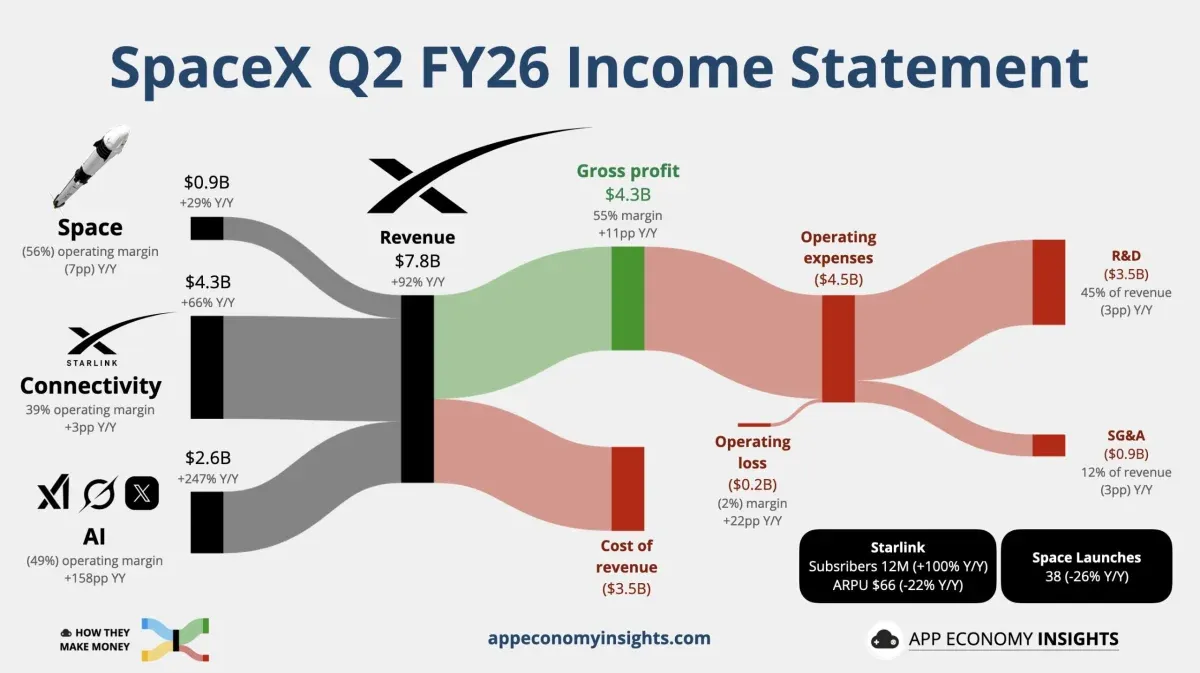
The connectivity division, which includes Starlink, generated second-quarter revenue of $4.29 billion, up nearly 66% year over year and more than 10% above the $3.83 billion consensus estimate.
Operating profit increased 79% to $1.66 billion, producing a margin of almost 39%. Connectivity was the only SpaceX segment to report a positive operating profit, effectively providing the cash-generating foundation for the company’s investments in Starship and AI.
Starlink ended the quarter with 12 million subscribers, double the number recorded a year earlier and 17% more than at the end of the first quarter. Average monthly revenue per subscriber declined from $85 to approximately $66 as SpaceX expanded into lower-priced international markets, but subscriber growth and rising enterprise and government demand more than offset that pressure.
SpaceX also highlighted Starshield, its military and national-security satellite platform. The company said Starshield had secured more than $6 billion in multiyear U.S. government contracts, improving revenue visibility and strengthening its position in secure communications and low-Earth-orbit defense networks.
Government orders provide stable, long-duration revenue, although they also expose part of SpaceX’s growth to federal budgets, procurement policies and regulatory decisions.
SpaceX’s traditional space division reported revenue of $962 million, up nearly 29% from a year earlier and above analysts’ estimate of $835 million.
Despite the revenue growth, the segment’s operating loss widened approximately 47% to $542 million. Its adjusted EBITDA loss was about $205 million, reflecting the continuing cost of Starship research, launch infrastructure, NASA missions and reusable-rocket development.
SpaceX completed two flight tests of its third-generation Starship vehicle during the 90 days preceding the report. The second V3 flight, conducted on July 24, deployed next-generation Starlink satellites for the first time, although the Super Heavy booster suffered another failure during its return.
Starship remains central to SpaceX’s long-term strategy. A fully reusable version could reduce launch costs, accelerate Starlink deployment and support lunar missions, deep-space exploration and the company’s proposed orbital data centers.
The earnings report nevertheless showed that Starship’s strategic value has not yet translated into segment profitability. Investors are still waiting for more precise schedules covering commercial launches, NASA mission milestones, in-orbit refueling and the recovery and reuse of Starship’s upper stage.
SpaceX’s AI business delivered the quarter’s fastest revenue growth, with sales increasing approximately 247% to $2.56 billion. That exceeded the market forecast of $2.18 billion and was almost three times the revenue generated by the company’s space division.
The segment includes xAI, the Grok model family and cloud infrastructure at the Colossus and Colossus 2 computing sites. SpaceX absorbed xAI in February as part of its strategy to combine artificial intelligence, connectivity, rockets and future space-based computing infrastructure.
AI’s operating loss narrowed 17.5% to approximately $1.26 billion. That was about 47% smaller than the $2.39 billion loss analysts had expected. The division also became adjusted-EBITDA positive for the first time, helped by an estimated $1.6 billion in incremental revenue from cloud-hosting agreements.
SpaceX disclosed $14.1 billion in new cloud-service contract sales, providing greater visibility into future AI revenue. However, contract value does not represent revenue recognized during the quarter and may be recorded over several years.
The company also launched Grok 4.5 in July and announced a $60 billion all-stock deal to acquire Anysphere, the developer of AI coding platform Cursor. The transaction adds another potential source of revenue but introduces questions about integration costs, shareholder dilution and the period required to generate a return.
The central concern was capital expenditure. SpaceX invested $15.8 billion in its AI division during the quarter, above the roughly $13.1 billion anticipated by analysts and more than double the $7.7 billion spent in the first quarter. By comparison, connectivity and space capital expenditures were approximately $1.37 billion and $1.17 billion, respectively.
Executives said third- and fourth-quarter capital spending would remain broadly comparable with the second-quarter level, offering no immediate indication that the company’s investment cycle has peaked.
SpaceX shares entered the earnings release with high expectations after gaining 9.4% during Tuesday’s regular session. The stock initially rose more than 1% after the report before reversing and falling as much as nearly 9%. It was recently down approximately 7% in extended trading.
The reaction reflected more than the quarterly results. SpaceX priced its June IPO at $135, and the stock subsequently reached a record of $225.64 on June 16. By Tuesday’s close, it had fallen approximately 44% from that peak, erasing more than $1 trillion from its highest post-listing market value.
Investors are also preparing for the first major lock-up expiration on August 6, which could make more than $100 billion of employee and early-investor shares eligible for sale. The possibility of additional supply may limit buying interest even after better-than-expected earnings.
The report confirmed that SpaceX is generating rapid revenue growth and that Starlink has developed into a scalable, profitable business. It also showed that the AI division is monetizing infrastructure faster and losing less money than analysts feared.
Wall Street’s focus now turns to whether Starlink can maintain subscriber growth, when Starship will begin supporting regular commercial operations and how quickly AI revenue can grow relative to capital spending. Until those questions become clearer, SpaceX remains dependent on Starlink profits to support two strategically important but capital-intensive businesses.
Risk Warning: This article is provided for informational purposes only and does not constitute investment advice, investment research, or a recommendation to trade. The views expressed are those of the author and do not necessarily reflect the position of Markets.com. When considering shares, indices, forex (foreign exchange), and commodities for trading and price predictions, remember that trading CFDs involves a significant degree of risk and may not be suitable for all investors. Leveraged products can result in capital loss. Past performance is not indicative of future results. Before trading, ensure you fully understand the risks involved and consider your investment objectives and level of experience. Cryptocurrency CFD trading restrictions may apply depending on jurisdiction.
Latest
View all
Tuesday, 4 August 2026
7 min

Tuesday, 4 August 2026
8 min

Tuesday, 4 August 2026
8 min

Tuesday, 4 August 2026
Indices
Gold Price Today, August 5: XAU/USD Edges Higher as Dollar Softens Ahead of US Jobs Data

Tuesday, 4 August 2026
Indices
Dow Jones Futures Rise 0.17% as Easing Middle East Tensions Lift Wall Street

Tuesday, 4 August 2026
Indices
SanDisk Stock Surges Nearly 11% Ahead of Q4 Earnings as AI Memory Optimism Returns

Tuesday, 4 August 2026
Indices
EUR/USD Edges Higher Near 1.15 as Lower Treasury Yields Pressure Dollar

Tuesday, 4 August 2026
Indices
AMD Stock Sinks as Record Q2 Results Fail to Clear Wall Street’s Higher AI Bar

Tuesday, 4 August 2026
Indices
Silver Price Forecast Shows XAG/USD Near $61 as Oil Selloff Eases Rate Fears

Tuesday, 4 August 2026
Indices
SpaceX Revenue Surges 92% in First Post-IPO Earnings as Starlink Profits Offset AI Spending

Tuesday, 4 August 2026
Indices
SK Hynix Stock Jumps 8%, Samsung Gains 4% as Korea’s Chip Rebound Accelerates


 EN
EN





