Access Restricted for EU Residents
You are attempting to access a website operated by an entity not regulated in the EU. Products and services on this website do not comply with EU laws or ESMA investor-protection standards.
As an EU resident, you cannot proceed to the offshore website.
Please continue on the EU-regulated website to ensure full regulatory protection.
Monday Aug 24 2026 02:53

6 min

Bitcoin remained above $77,000 on Monday after delivering its strongest weekly performance in more than three years, supported by institutional inflows, improving US regulatory expectations and a major short squeeze.
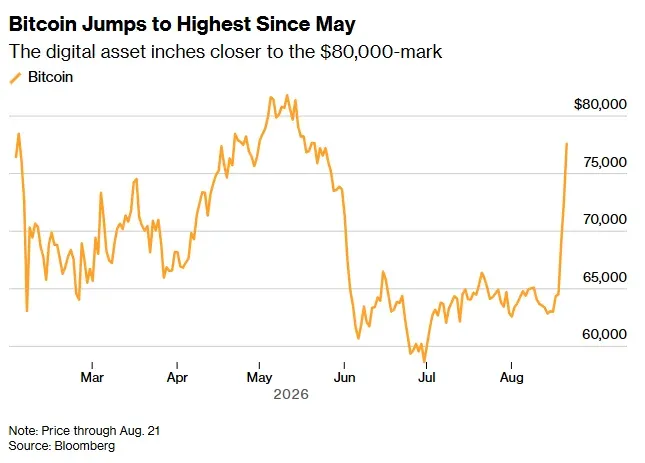
BTC was trading at approximately $77,700 during early trading on August 24, little changed from the previous session. The cryptocurrency traded between roughly $75,680 and $78,030 over the weekend after reaching a three-month high above $79,300 on Friday.
Bitcoin gained more than 20% over the previous week, with estimates ranging between 22% and 24% depending on the exchange and weekly closing time used. The move was its strongest since March 2023 and lifted the asset approximately 30% above its March 2026 low.
The breakout also ended a prolonged period in which Bitcoin repeatedly failed to move decisively above the $65,000 area. Historical price data showed BTC rising 7.1% on August 19, 5.3% on August 20 and another 7.3% on August 21.
One of the first catalysts came from the US Treasury Department, which announced that it would at least double the size of its liquidity-support buybacks for longer-dated government debt.
The maximum size of operations covering securities with maturities between 10 and 30 years will increase from $2 billion to at least $4 billion, beginning September 9. The announcement initially pushed long-term Treasury yields lower and weakened the US dollar.
Bitcoin, gold and other assets perceived as alternatives to government-issued currencies subsequently moved higher. Some investors interpreted the Treasury’s decision as evidence of rising concern about liquidity in the US bond market and the sustainability of a national debt burden that has exceeded $40 trillion.
However, the buybacks do not constitute quantitative easing. The Treasury will be repurchasing older, less-liquid securities as part of its debt-management operations rather than creating new central-bank reserves. The initial price response therefore reflected changes in market expectations and positioning more than a direct injection of liquidity.
Bitcoin’s ability to maintain its gains will partly depend on whether investors continue treating the policy as supportive for scarce assets or begin viewing it as a temporary bond-market measure.
Institutional demand provided stronger confirmation of the rally.
US spot Bitcoin exchange-traded funds attracted approximately $1.6 billion in net inflows between Monday and Thursday. The funds took in about $606 million on Thursday alone, their largest daily total since May, according to ETF flow data reported by The Wall Street Journal.
BlackRock’s IBIT accounted for a substantial share of those inflows. Demand also extended to Ether funds, suggesting that the recovery was not limited to Bitcoin.
ETF inflows matter because they represent spot-market demand rather than leveraged derivatives exposure. If inflows continue after Bitcoin’s initial breakout, they could help absorb profit-taking from investors who purchased BTC near the March lows.
The rally also lifted cryptocurrency-related equities. Coinbase gained more than 9% during Friday’s session, while Strategy advanced about 8%. Robinhood and several Bitcoin-mining companies also benefited as investors increased their exposure to the digital-asset market.
Political developments in Washington supplied another catalyst.
President Donald Trump urged Congress to advance the CLARITY Act following a White House meeting with cryptocurrency industry executives. The legislation is intended to establish clearer federal oversight of digital assets and define the responsibilities of US regulatory agencies.
The House previously approved the proposal, but it remains stalled in the Senate. A procedural vote expected in September could determine whether the legislation advances before the US midterm elections.
The market viewed Trump’s intervention as a sign that the administration is prepared to prioritize crypto regulation. Greater legal clarity could make traditional financial institutions more comfortable offering custody, trading and tokenization services.
Nevertheless, supportive political statements do not guarantee that the legislation will pass. Disagreements remain over investor protections, stablecoin oversight and the division of authority between the Securities and Exchange Commission and Commodity Futures Trading Commission.
The speed of the move was also influenced by derivatives positioning.
Weeks of range-bound trading below $65,000 had encouraged traders to build short positions. Once Bitcoin broke through that ceiling, exchanges automatically closed leveraged bearish positions, creating forced market purchases.
Approximately $709 million in Bitcoin shorts were liquidated during one 24-hour period as BTC approached $79,000. Estimates for total crypto-market liquidations were considerably higher because the rally extended to Ether, Solana, XRP and other assets.
This mechanism created a feedback loop: rising prices triggered liquidations, forced purchases pushed prices higher and the additional advance closed more short positions.
Short covering can produce sharp gains, but it does not guarantee a lasting uptrend. Once bearish leverage has been removed, the market requires continuing spot purchases and ETF demand to support higher prices.
The $79,000–$80,000 region is now Bitcoin’s most immediate resistance area. BTC briefly traded above $79,300 on Friday but failed to establish a sustained move above that level.
A decisive break through $80,000 could reinforce the bullish structure and attract momentum traders. However, Bitcoin remains more than 38% below its 52-week high of approximately $126,000, leaving substantial overhead supply from investors who bought at higher prices.
On the downside, the $75,000–$76,000 area represents the first important support zone. A break below it could expose $72,000, followed by the former breakout region around $69,000–$70,000.
This week’s Nvidia earnings and Federal Reserve Chair Kevin Warsh’s Jackson Hole address could also influence Bitcoin through changes in the dollar, Treasury yields and overall risk appetite.
Bitcoin’s latest rally has stronger support than a purely speculative price spike because it combines ETF inflows, political catalysts and renewed demand for alternative assets. However, maintaining the move above $77,000 will require buyers to continue participating after the short squeeze fades.
Risk Warning: This article is provided for informational purposes only and does not constitute investment advice, investment research, or a recommendation to trade. The views expressed are those of the author and do not necessarily reflect the position of Markets.com. When considering shares, indices, forex (foreign exchange), and commodities for trading and price predictions, remember that trading CFDs involves a significant degree of risk and may not be suitable for all investors. Leveraged products can result in capital loss. Past performance is not indicative of future results. Before trading, ensure you fully understand the risks involved and consider your investment objectives and level of experience. Cryptocurrency CFD trading restrictions may apply depending on jurisdiction.
Latest
View all
Sunday, 23 August 2026
7 min

Sunday, 23 August 2026
6 min

Sunday, 23 August 2026
7 min

Sunday, 23 August 2026
Indices
Gold Price Today, August 24, 2026: Gold Tops $4,620 as Debt Fears Put Record August Gain in Sight

Sunday, 23 August 2026
Indices
Robinhood Stock Jumps 13.7% as Bitcoin Rally and CLARITY Act Hopes Lift Crypto Shares

Sunday, 23 August 2026
Indices
Samsung Electronics Stock Drops 8% as Record $80 Billion Payout Disappoints

Sunday, 23 August 2026
Indices
US Canada Trade War Escalates as Trump Imposes 50% Tariffs on $20 Billion of Goods

Sunday, 23 August 2026
Indices
Oil Price Today Falls 1% Ahead of Trump Administration’s New Iran Sanctions

Sunday, 23 August 2026
Indices
Bitcoin Price Today Holds Above $77,000 After Its Strongest Weekly Rally Since 2023


 EN
EN