
Access Restricted for EU Residents
You are attempting to access a website operated by an entity not regulated in the EU. Products and services on this website do not comply with EU laws or ESMA investor-protection standards.
As an EU resident, you cannot proceed to the offshore website.
Please continue on the EU-regulated website to ensure full regulatory protection.
Thursday Aug 20 2026 02:46

5 min
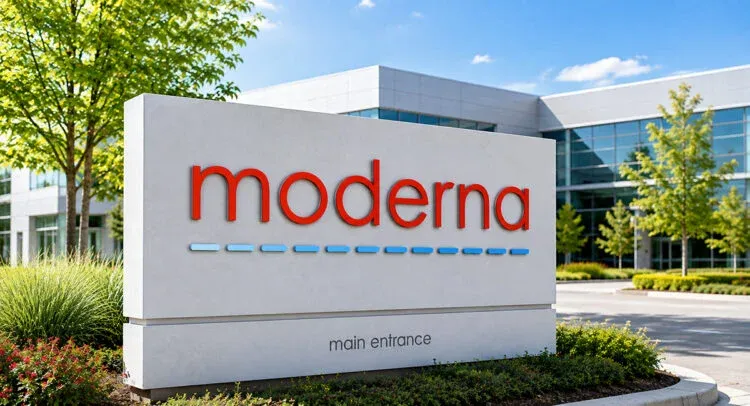
Moderna shares recorded their biggest one-day gain on record after the biotechnology company and Merck announced positive Phase 3 results for a personalized mRNA cancer vaccine in patients with high-risk melanoma.
Moderna stock closed Wednesday at $174.38, surging 177.2% and reaching its highest level in three years. The rally added roughly $44 billion to the company’s market capitalization, lifting it to about $69.4 billion. Merck shares advanced 12.6% to a record $152.20. Market data showed Moderna traded almost 200 million shares during the session.

The INTerpath-001 study evaluated intismeran autogene, previously known as V940 or mRNA-4157, in combination with Merck’s Keytruda. The treatment was administered after surgery to patients with completely resected Stage IIB through Stage IV melanoma who remained at high risk of recurrence.
According to the companies, the combination produced statistically significant and clinically meaningful improvements in both recurrence-free survival and distant metastasis-free survival when compared with Keytruda alone. The first endpoint measures how long patients remain alive without their cancer returning, while the second tracks whether the disease spreads to another part of the body.
No unexpected safety findings were identified, and the treatment’s safety profile remained consistent with previous studies. However, Moderna and Merck did not disclose the Phase 3 hazard ratios, absolute survival rates or overall-survival results. The companies plan to present the complete findings at an international medical conference and discuss potential regulatory submissions with health authorities. Merck’s official announcement described the result as supporting a more personalized approach to cancer treatment.
Intismeran is a therapeutic cancer vaccine rather than a preventive vaccine. Doctors first analyze genetic material from an individual patient’s tumor to identify mutations unique to that cancer. Moderna then produces a customized dose containing synthetic mRNA instructions for as many as 34 tumor-specific neoantigens.
The goal is to train the patient’s immune system to recognize and attack cells carrying those mutations. Keytruda, meanwhile, blocks the PD-1 pathway that cancer cells can use to suppress the immune response. Combining the two treatments is intended to help the immune system identify the cancer while removing one of the mechanisms that allows malignant cells to escape detection.
The individualized manufacturing process represents both the program’s main scientific advantage and a potential commercial challenge. Every treatment must be designed and produced for a specific patient, creating questions about manufacturing speed, cost, reimbursement and large-scale distribution.
Earlier Phase 2 findings had already made the program one of Moderna’s most valuable non-COVID assets. In that study, intismeran plus Keytruda reduced the risk of recurrence or death by 49% and lowered the risk of distant metastasis or death by 59% compared with Keytruda alone.
Those figures must not be confused with the new Phase 3 outcome, for which the detailed risk reductions remain undisclosed. Nevertheless, meeting both late-stage endpoints provides stronger confirmation that the benefit observed in the smaller study was not a statistical anomaly. Analysts described the result as the first positive Phase 3 readout for an individualized neoantigen therapy. Investor’s Business Daily reported that some analysts estimate the melanoma opportunity could eventually be worth around $2.5 billion.
The clinical breakthrough was the fundamental catalyst, but market positioning likely magnified the move. Around 13.7% of Moderna’s publicly traded shares had been sold short before the announcement, leaving bearish investors exposed to a sharp squeeze when the positive result arrived.
Moderna’s gain lifted its 2026 advance to approximately 445%, although the stock remains well below its August 2021 record near $484. The rally also spread across the mRNA sector, with BioNTech climbing more than 20% as investors reassessed the broader potential of personalized cancer vaccines.
The result could help Moderna establish a major business beyond respiratory vaccines. The company and Merck are already studying the technology in other tumor types, including lung, kidney and bladder cancers. Still, the market will need the full Phase 3 dataset before determining the treatment’s precise clinical and commercial value.
Investors will now focus on the magnitude and durability of the benefit, patient subgroups, manufacturing readiness and the regulatory timetable. Analysts have suggested a possible US approval in 2027, but that remains an expectation rather than confirmed guidance. Moderna’s 177% rally reflects a genuine scientific milestone, yet converting that breakthrough into a scalable and profitable oncology franchise will be the company’s next test.
Explore Stock CFDs with Markets.com and trade price movements across leading global companies. Claim up to $5,000 in bonuses and start trading today.
Risk Warning: This article is provided for informational purposes only and does not constitute investment advice, investment research, or a recommendation to trade. The views expressed are those of the author and do not necessarily reflect the position of Markets.com. When considering shares, indices, forex (foreign exchange), and commodities for trading and price predictions, remember that trading CFDs involves a significant degree of risk and may not be suitable for all investors. Leveraged products can result in capital loss. Past performance is not indicative of future results. Before trading, ensure you fully understand the risks involved and consider your investment objectives and level of experience. Cryptocurrency CFD trading restrictions may apply depending on jurisdiction.
Latest
View all
Wednesday, 19 August 2026
6 min

Wednesday, 19 August 2026
5 min

Tuesday, 18 August 2026
5 min

Wednesday, 19 August 2026
Indices
Gold Price Today, August 20: Gold Holds Near $4,500 as Treasury Buybacks Sink Yields

Wednesday, 19 August 2026
Indices
Chip Stocks Diverge: SK Hynix Jumps 6% on $29 Billion Buyback as Broadcom Slides
Wednesday, 19 August 2026
Indices
Moderna Stock Soars 177% as Cancer Vaccine Delivers a Landmark Phase 3 Win

Wednesday, 19 August 2026
Indices
Marvell Stock Jumps 9.9% on Google AI Chip Deal as Broadcom Falls 4.6%

Wednesday, 19 August 2026
Indices
US National Debt Hits $40 Trillion as Interest Costs Raise New Market Risks

Tuesday, 18 August 2026
Indices
Gold Price Today, August 19, 2026: Gold Rebounds Near $4,355 as Fed Minutes Loom


 EN
EN





