
Access Restricted for EU Residents
You are attempting to access a website operated by an entity not regulated in the EU. Products and services on this website do not comply with EU laws or ESMA investor-protection standards.
As an EU resident, you cannot proceed to the offshore website.
Please continue on the EU-regulated website to ensure full regulatory protection.
Tuesday Aug 4 2026 02:34

8 min

Palantir Technologies shares rallied in extended trading after the artificial intelligence software company delivered stronger-than-expected second-quarter results and sharply raised its 2026 revenue and profit forecasts.
The company reported quarterly revenue of $1.94 billion, up 93% from a year earlier and comfortably above Wall Street’s roughly $1.8 billion estimate. Adjusted earnings reached $0.41 per share, surpassing expectations of approximately $0.34 to $0.35. Palantir shares gained as much as 13% to 14% following the announcement.

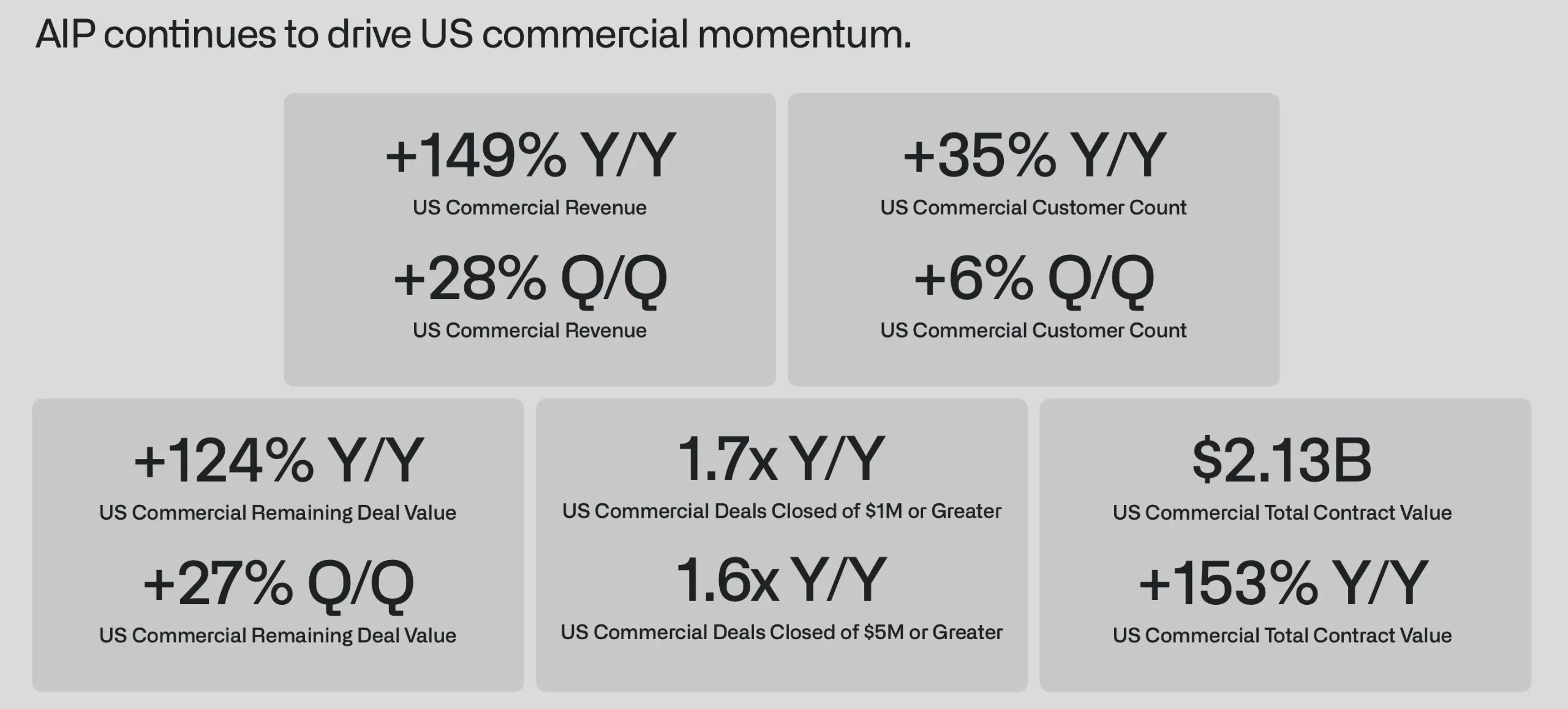
Palantir’s U.S. commercial revenue soared 149% year over year to $764 million, substantially exceeding the approximately $716.4 million expected by analysts. Total second-quarter revenue increased 93% to $1.94 billion, while the company lifted its full-year revenue forecast to between $8.150 billion and $8.158 billion—well above the roughly $7.7 billion consensus. Chief Executive Alex Karp attributed the results to exceptional demand for what he calls “AI sovereignty,” arguing that customers want to retain control over their data and institutional knowledge. The report sent Palantir shares sharply higher after the closing bell.
Indicator | Actual | Forecast |
|---|---|---|
Revenue | $1.935 Billion | $1.809 Billion |
Adjusted EPS | $0.41 | $0.35 |
US Commercial Revenue | $764 Million | $716 Million |
US Government Revenue | $809 Million | $733 Million |
Palantir’s U.S. commercial division was the standout performer. Revenue from the segment reached $764 million, representing growth of 149% from the same period last year and 28% from the previous quarter.
U.S. government revenue also remained strong, rising 90% year over year to $809 million. Together, the two businesses pushed total U.S. revenue to $1.57 billion, an increase of 115%.
The company signed 220 contracts worth at least $1 million during the quarter, including 98 agreements valued at $5 million or more and 73 worth at least $10 million. Total contract value reached $3.37 billion, while U.S. commercial contract value climbed 153% to $2.13 billion.
Profitability expanded alongside revenue. Palantir recorded GAAP operating income of $912 million, equivalent to a 47% margin. Adjusted operating income was $1.19 billion, producing a 62% margin.
Operating cash flow reached $1.22 billion, and adjusted free cash flow was also approximately $1.22 billion. Palantir ended the quarter with around $9.2 billion in cash, cash equivalents and short-term U.S. Treasury securities.
Palantir expects third-quarter revenue of $2.160 billion to $2.164 billion, above the roughly $2 billion analysts had projected. Adjusted operating income is forecast at between $1.292 billion and $1.296 billion.
For the full year, management raised its revenue outlook to $8.150 billion to $8.158 billion. Its previous forecast had called for approximately $7.65 billion to $7.66 billion.
The company now expects U.S. commercial revenue to exceed $3.424 billion, which would represent growth of at least 134%. That compares with its earlier forecast of more than $3.224 billion.
Palantir also increased its adjusted operating income guidance to between $4.889 billion and $4.897 billion. Adjusted free cash flow is expected to reach $4.5 billion to $4.7 billion.
Management reaffirmed that Palantir expects to generate GAAP operating income and net income in every quarter of 2026.
Although Palantir’s domestic operations expanded rapidly, its international business grew at a more moderate rate. Revenue outside the United States increased 33% to $362.5 million, leaving overseas markets responsible for about 19% of total sales.
The gap reflects, in part, growing pressure in Europe to reduce dependence on American technology suppliers. France’s domestic intelligence agency has been preparing to replace Palantir software with technology supplied by French company ChapsVision, illustrating how national-security concerns are encouraging governments to support local alternatives. Other European countries are also examining their reliance on foreign technology providers, although replacing established systems could take years.
In the United States, meanwhile, Palantir continues to strengthen its defense business. Reuters reported that Palantir and defense technology company Anduril have been developing software connected to the Trump administration’s Golden Dome missile-defense initiative.
Karp described the quarter as “otherworldly” and said demand for AI sovereignty had been unleashed. His argument is that businesses and governments do not want external model developers to gain unrestricted access to their operational data, prompts and decision-making processes.
The comments directly addressed concerns that large-language-model developers such as Anthropic could eventually build software that replaces parts of Palantir’s platform. Karp instead positioned Palantir as the secure operating layer that allows customers to deploy AI while maintaining control of proprietary information and organizational intelligence.
Founded in 2003, Palantir offers AIP for deploying AI applications, Gotham for defense and intelligence operations, Foundry for commercial data management and Apollo for software deployment. The company has increasingly aligned its corporate identity with U.S. national-security priorities.
The second-quarter results eased immediate concerns about whether Palantir’s growth could support its premium valuation. However, investors will continue watching whether the company can sustain its rapid U.S. commercial expansion while navigating mounting technology-sovereignty pressures overseas.
Risk Warning: This article is provided for informational purposes only and does not constitute investment advice, investment research, or a recommendation to trade. The views expressed are those of the author and do not necessarily reflect the position of Markets.com. When considering shares, indices, forex (foreign exchange), and commodities for trading and price predictions, remember that trading CFDs involves a significant degree of risk and may not be suitable for all investors. Leveraged products can result in capital loss. Past performance is not indicative of future results. Before trading, ensure you fully understand the risks involved and consider your investment objectives and level of experience. Cryptocurrency CFD trading restrictions may apply depending on jurisdiction.
Latest
View all
Monday, 3 August 2026
4 min

Monday, 3 August 2026
6 min

Monday, 3 August 2026
6 min

Monday, 3 August 2026
Indices
Gold Price Today, August 4: Gold Edges Higher Near $4,060 Ahead of US Labor Data

Monday, 3 August 2026
Indices
Palantir Stock Surges as U.S. Commercial Revenue Jumps 149% and 2026 Guidance Rises

Monday, 3 August 2026
Indices
Amazon Joins the $3 Trillion Club as AWS Chief Says AI Demand Is Outstripping Supply


 EN
EN





