
Access Restricted for EU Residents
You are attempting to access a website operated by an entity not regulated in the EU. Products and services on this website do not comply with EU laws or ESMA investor-protection standards.
As an EU resident, you cannot proceed to the offshore website.
Please continue on the EU-regulated website to ensure full regulatory protection.
Friday Jul 31 2026 03:17

22 min

A spread in trading is the difference between the buy (ask) price and the sell (bid) price of an instrument — and it's the most fundamental cost you pay on every trade. If EUR/USD shows a sell price of 1.1000 and a buy price of 1.1002, the spread is 2 pips: the built-in amount your position must recover before it's in profit. The same mechanic applies whether you're trading forex, gold, indices, or crypto as CFDs.
This guide explains everything the term covers: how bid and ask prices work, how to calculate what a spread actually costs you in money, fixed versus variable spreads, why spreads widen at the worst moments, and how to keep this cost as small as possible.
Look closely at any trading platform and you'll see every instrument carries two prices at once:
The bid — the price at which you can sell (the highest price buyers will pay).
The ask — the price at which you can buy (the lowest price sellers will accept).
The spread is simply ask minus bid. It exists because markets are a meeting point between buyers and sellers, and the gap between what each side will accept is where brokers and liquidity providers earn their facilitation cost. That's why the spread is often called the "invisible" fee: nothing is billed separately — the cost is embedded in the two prices themselves.
The practical consequence every new trader notices: the moment you open a position, it shows a small loss. That's not an error — it's the spread. You bought at the ask, and the platform values your position at the bid. Price has to move in your favour by the spread's width before you reach break-even.

The formula could not be simpler:
Spread = Ask price − Bid price
In forex, the result is expressed in pips — the standard smallest move of a currency pair (the fourth decimal place for most pairs, second for JPY pairs). If EUR/USD is quoted 1.1000 / 1.1002, the spread is 0.0002 = 2 pips. On other CFD markets, the same gap is usually quoted in points: gold at 2,410.30 / 2,410.70 has a 40-cent spread; an index quoted 5,500.0 / 5,501.0 has a 1-point spread.
Pips and points are only labels, though. What matters is converting them into money.
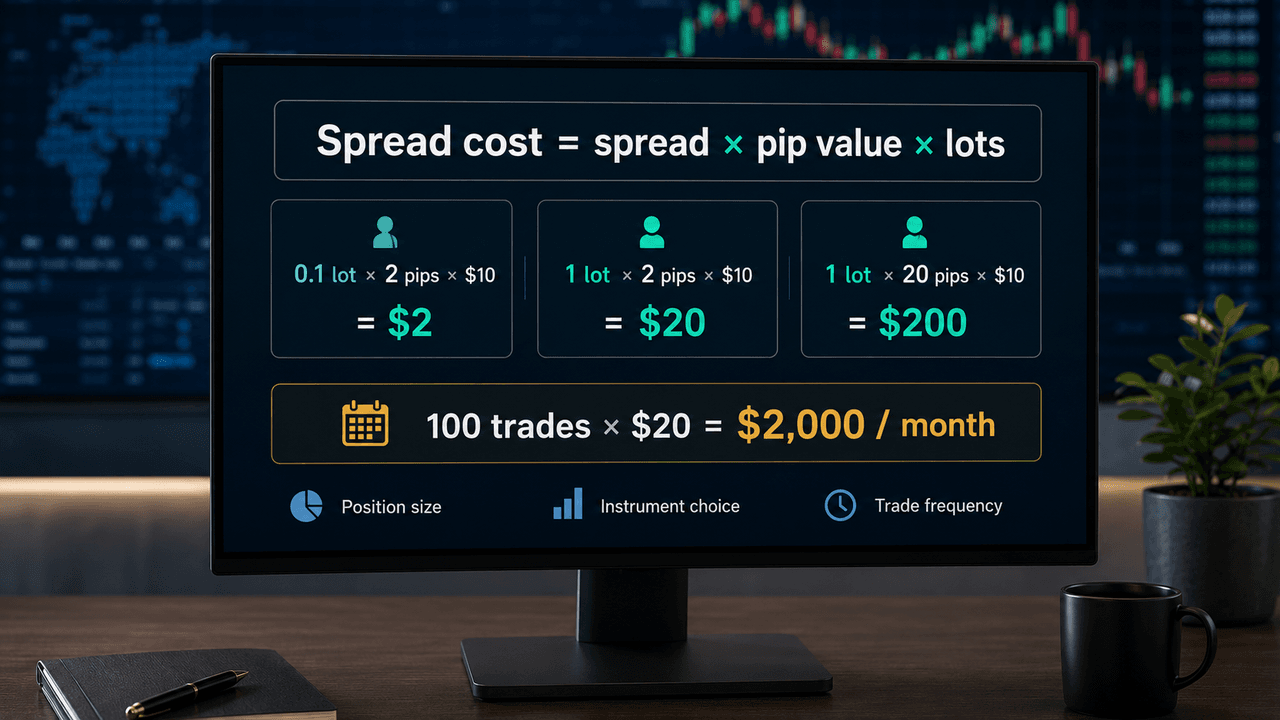
To turn a spread into a dirham-and-dollar cost, use:
Spread cost = spread (in pips) × pip value × number of lots
For USD-quoted major pairs, one standard lot (100,000 units) has a pip value of about $10. So:
Trade | Spread | Calculation | Cost to open |
|---|---|---|---|
1.0 lot EUR/USD | 2 pips | $2 x $10 x 1.0 | $20 |
0.1 lot EUR/USD | 2 pips | $2 x $10 x 0.1 | $2 |
1.0 lot exotic pair | 20 pips | $20 x $10 x 1.0 | $200 |
Two lessons hide in that table. First, position size scales the cost — the same spread costs a scalper trading full lots ten times what it costs a cautious beginner on mini lots. Second, instrument choice can change the cost by an order of magnitude: that exotic pair costs ten times the major before the trade has gone anywhere. Frequent traders should multiply by their monthly trade count — 100 trades on a 2-pip spread at one lot is $2,000 of spread cost per month — which is why active traders obsess over tight pricing, and why our lowest spread CFD brokers comparison exists.
Brokers quote spreads in two flavours, and the difference matters more than most beginners realise.
Fixed spreads stay constant regardless of market conditions — the same width at a quiet midnight as during a payrolls release. They're typically offered by market-maker ("dealing desk") brokers, and their appeal is predictability: you always know your cost, which helps when planning trades around news.
Variable (floating) spreads move with the market — tightening below the fixed equivalent in calm, liquid conditions and widening in volatile or thin ones. They're the norm at brokers using non-dealing-desk pricing fed by liquidity providers, and they're usually cheaper on average, with the trade-off that your cost is briefly unknowable at exactly the moments markets go wild.
Neither is "better" universally: news traders and cost-certain planners lean fixed; most active traders accept variable for the tighter average. Whichever your platform uses, the next section explains when and why the variable kind stretches.
A spread is a live price for liquidity — so it widens exactly when liquidity gets scarce or risky to provide:
A widening spread often travels with its cousin, slippage — getting filled at a worse price than you clicked — because both are symptoms of the same thin liquidity. The practical rule: the moments that feel most exciting to trade are precisely the moments trading costs the most.
One advantage of understanding spreads is that the knowledge transfers across every CFD market — only the magnitudes change:
Market | Typical spread behaviour |
|---|---|
Forex majors (EUR/USD, GBP/USD) | Tightest of all — deepest liquidity in the world |
Forex minors & exotics | Wider; exotics can be 10 x a major |
Gold (XAU/USD) | Tight for a commodity; widens sharply on risk events |
Major indices (US 500, US Tech 100) | Very tight during home-exchange hours; wider overnight |
Shares CFDs | Varies by stock liquidity; blue chips tightest |
Crypto (BTC, ETH) | Widest of the majors — a volatility premium, 24/7 |
The pattern is universal: liquidity in, spread down; volatility up, spread up. It's why the same account can pay a fraction of a pip on EUR/USD at London open and dramatically more on an altcoin at 3am — and why crypto CFD traders in particular must budget for the spread as a first-class cost.
The spread is the most visible trading cost, but comparing platforms on spread alone is how traders get fooled. There are three cost components:
The honest comparison is always spread + commission + swaps for how you trade. A zero-commission account with a 1.5-pip spread beats a raw-spread account with commission for an occasional trader — and loses to it badly for a scalper.
The same spread weighs very differently on different strategies:
A useful habit regardless of style: know your spread-to-target ratio. If the spread is more than a small fraction of your expected move, the trade's economics are working against you before the market has voted.
For UAE traders, moving from education to practical CFD trading begins with choosing an appropriate provider, understanding the underlying market and testing a written plan before committing capital.
Careful research and risk management remain necessary because CFDs are leveraged products and losses can occur even when a trade follows the written plan.
Opening a CFD account on Markets.com takes just a few minutes, whether on the website or mobile app. Follow these five steps to go from sign-up to your first trade.
Step 1: Sign Up for an Account
Visit Markets.com or download the app, click "Create Account," and register with your email or a Google/Facebook/Apple account.

Step 2: Verify Your Identity (KYC)
Complete the KYC check by entering your personal details and uploading proof of identity and address.
Step 3: Fund Your Account
Deposit via card, bank transfer, e-wallet, Apple Pay, or Google Pay. The minimum deposit is $100.

Step 4: Choose a Market and Place Your Trade
Select an asset like gold, forex, or shares. Choose Buy if you expect the price to rise, Sell if you expect it to fall, and set a stop-loss and take-profit before confirming.

Step 5: Manage and Close Your Positions
Monitor open trades, adjust risk settings as needed, and close positions manually or automatically when targets are hit.
New to Markets.com? Claim a generous deposit bonus on your first trade. Hurry—this offer is only available for a limited time.

So, what is a spread in trading? It's the gap between the buy and sell price — the built-in cost of every position, paid in forex, CFD, and every other market alike. Calculate it in pips, convert it to money with pip value and lot size, and it stops being invisible: you'll see why every trade opens slightly negative, why costs spike around news and thin hours, and why the honest way to compare platforms is spread plus commission plus swaps for your own style. Understand the spread and you understand the price of admission to every market you'll ever trade — and how to pay less of it.
It's the difference between the price you can buy at (ask) and the price you can sell at (bid). If gold shows 2,410.30 / 2,410.70, the 40-cent gap is the spread — the cost built into opening the trade.
Because of the spread. You buy at the ask price but the position is valued at the lower bid price, so it opens negative by exactly the spread's width. Price must move that far in your favour before you break even.
Context decides. Major pairs like EUR/USD typically carry the tightest spreads in trading — often around a pip or less in liquid hours — while exotics run many times wider. "Good" means tight relative to that instrument's norm, during liquid sessions, at a regulated broker.
Neither universally. Fixed spreads give cost certainty, including through news; variable spreads are usually cheaper on average but widen in volatility. Frequent traders in liquid hours generally pay less with variable; news-window traders may prefer fixed.
Multiply the spread in pips by the pip value and your lot size. A 2-pip spread × $10 pip value × 1 standard lot = $20 per trade. Multiply by your monthly trade count to see why active traders prioritise tight spreads.
Liquidity providers don't know the outcome of a data release any more than you do, so they widen spreads to price that uncertainty — and thin liquidity around the event amplifies it. Costs are highest at precisely the most tempting moments to trade.
Babypips, What Is a Spread in Forex Trading? — https://www.babypips.com/learn/forex/what-is-a-spread-in-forex-trading
Investopedia, Financial Spreads: Definitions and Trading Implications — https://www.investopedia.com/terms/s/spread.asp
Risk Warning: This article is provided for informational purposes only and does not constitute investment advice, investment research, or a recommendation to trade. The views expressed are those of the author and do not necessarily reflect the position of Markets.com. When considering shares, indices, forex (foreign exchange), and commodities for trading and price predictions, remember that trading CFDs involves a significant degree of risk and may not be suitable for all investors. Leveraged products can result in capital loss. Past performance is not indicative of future results. Before trading, ensure you fully understand the risks involved and consider your investment objectives and level of experience. Cryptocurrency CFD trading restrictions may apply depending on jurisdiction.
Latest
View all
Thursday, 30 July 2026
21 min

Thursday, 30 July 2026
24 min

Thursday, 30 July 2026
32 min


 EN
EN





