
Access Restricted for EU Residents
You are attempting to access a website operated by an entity not regulated in the EU. Products and services on this website do not comply with EU laws or ESMA investor-protection standards.
As an EU resident, you cannot proceed to the offshore website.
Please continue on the EU-regulated website to ensure full regulatory protection.
Friday Jul 31 2026 06:11

21 min

Leverage in trading lets you control a position far larger than the money you put down: at 30:1 leverage, a $1,000 deposit controls a $30,000 position. Margin is that deposit — the collateral your broker sets aside to keep the position open. Together they're the defining mechanic of CFD and forex trading, and the most misunderstood one, because leverage magnifies losses exactly as efficiently as gains.
This guide explains what leverage and margin are, how they work with real numbers, what margin calls and stop-outs actually mean, and — most importantly — how to manage leveraged risk so one bad trade never becomes an account-ending event.
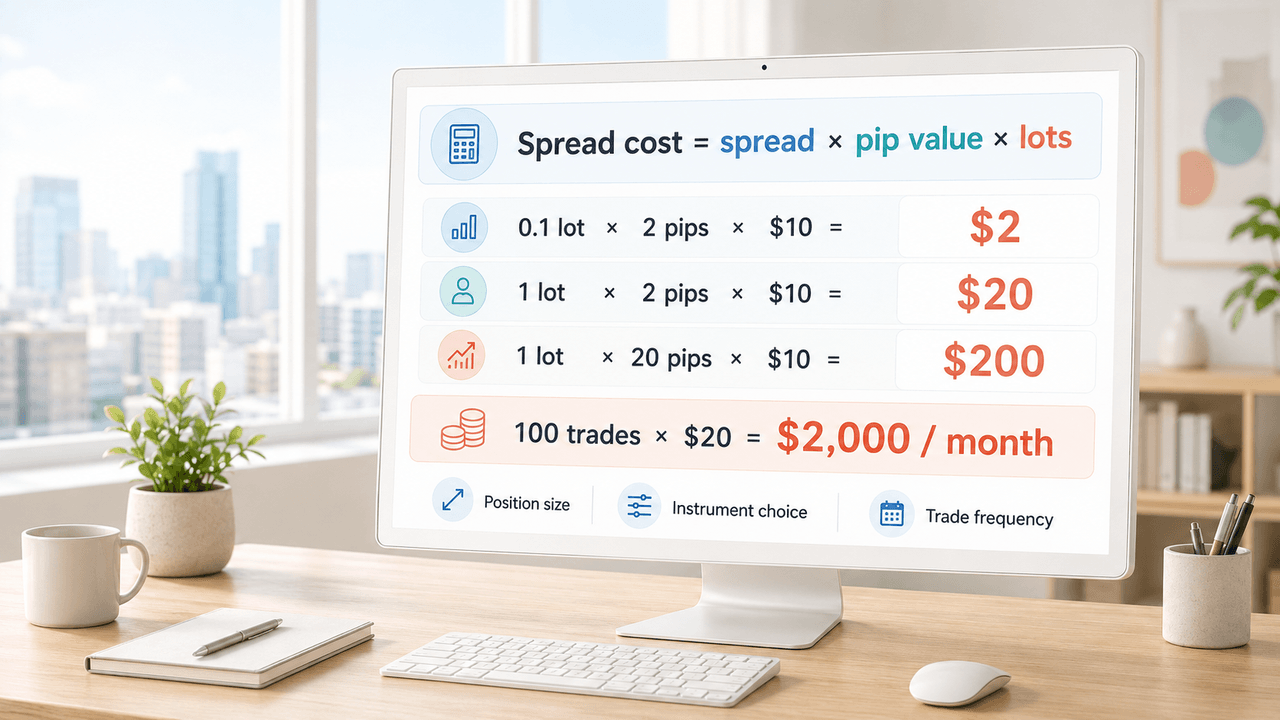
Leverage is borrowed market exposure. Instead of paying the full value of a position, you put down a fraction of it — the margin — and your broker provides the rest of the exposure. The ratio between the two is the leverage: 10:1, 20:1, 30:1.
The critical point that separates traders who survive from those who don't: your profit and loss are calculated on the full position value, not your deposit. Control $30,000 of EUR/USD with $1,000, and a 1% move in the pair changes your account by $300 — 30% of your margin — in either direction. Leverage doesn't create opportunity out of nothing; it concentrates the same market move onto a smaller amount of your capital.
That's why every asset class gets a different cap. Retail leverage limits typically run highest on major forex pairs (often 30:1 under major regulators), lower on gold and indices, lower again on shares, and lowest on crypto — the ladder tracks volatility.
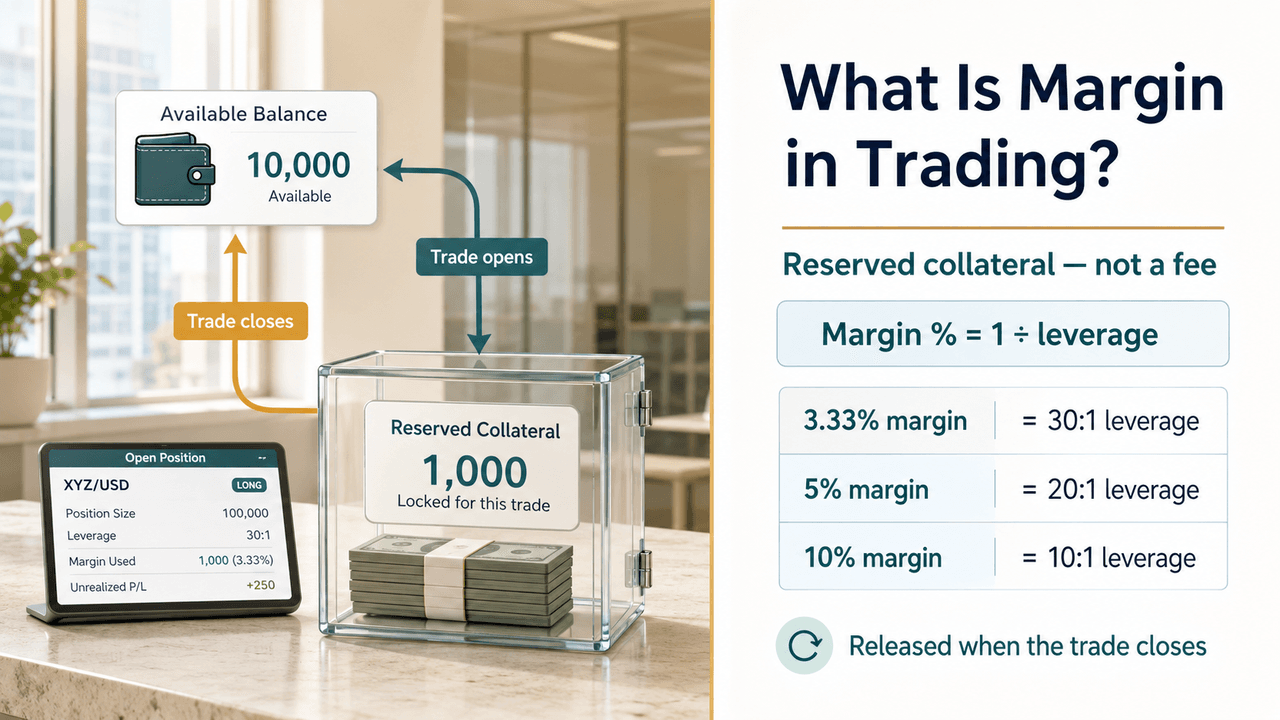
Margin is the money the leverage stands on: the portion of your own capital your broker reserves as collateral when you open a leveraged position. Two things beginners consistently get wrong about it:
Leverage | Margin requirement | Margin to control $30,000 |
|---|---|---|
30:1 | 3.33% | $1,000 |
20:1 | 5% | $1,500 |
10:1 | 10% | $3,000 |
5:1 | 20% | $6,000 |
2:1 | 50% | $15,000 |
Once positions are open, your platform tracks three numbers that decide everything about your account's health:
Margin level is the number to watch. It falls as floating losses grow, and your broker's rules hang off it: at one threshold you get a margin call; at a lower one, positions start being force-closed. A trader with 800% margin level has room to breathe through volatility; one hovering at 120% is one bad candle from trouble. Keeping free margin comfortably larger than used margin isn't conservatism — it's the whole game of staying solvent through normal market noise.
These two terms get confused, and the difference matters.
A margin call is the warning. When your margin level falls below the broker's call threshold, you're notified that your account can no longer comfortably support its positions. Your options: close or reduce positions, or add funds. It's the market telling you your sizing was too big for your capital.
A stop-out is the consequence. If the margin level keeps falling to the stop-out threshold, the platform starts force-closing your positions automatically — usually largest loser first — until the margin level recovers. Nobody asks your opinion; the math executes. This is the same mechanic behind the mass "liquidations" you read about in crypto crash headlines: thousands of stop-outs firing at once, each one adding selling pressure that triggers the next.
Thresholds vary by broker and entity, so know yours before you fund. Most regulated brokers also provide negative balance protection for retail clients, meaning you can't lose more than your account balance — a backstop worth confirming, never a strategy.
Meet Daniel in London, with a $5,000 account, trading gold. He wants to risk the same $100 on a trade with a stop loss 1% away from entry. Watch what leverage choice does:
Same trader, same market, same stop distance. The only difference is whether position size came from his risk budget or from the platform's maximum. That choice — not the leverage cap itself — is what decides outcomes.
Three asymmetries make leveraged losses more dangerous than the simple multiplication suggests:
None of this makes leverage "bad" — it makes it a professional tool with amateur-friendly packaging. The caps regulators impose are guardrails, not recommendations.
Everything above condenses into six habits:
The framework travels everywhere, only the numbers change. Major forex pairs carry the highest caps and lowest margin requirements; gold and major indices sit in the middle tier; single shares require more margin again; crypto demands the most margin per dollar of exposure because it moves the most. The instrument's volatility, times your effective leverage, is your real risk setting — which is why a modestly leveraged crypto position can carry more practical risk than a fully leveraged forex major.
The same handful of errors sits behind most margin calls:
For UAE traders, moving from education to practical CFD trading begins with choosing an appropriate provider, understanding the underlying market and testing a written plan before committing capital.
Careful research and risk management remain necessary because CFDs are leveraged products and losses can occur even when a trade follows the written plan.
Opening a CFD account on Markets.com takes just a few minutes, whether on the website or mobile app. Follow these five steps to go from sign-up to your first trade.
Step 1: Sign Up for an Account
Visit Markets.com or download the app, click "Create Account," and register with your email or a Google/Facebook/Apple account.

Step 2: Verify Your Identity (KYC)
Complete the KYC check by entering your personal details and uploading proof of identity and address.
Step 3: Fund Your Account
Deposit via card, bank transfer, e-wallet, Apple Pay, or Google Pay. The minimum deposit is $100.

Step 4: Choose a Market and Place Your Trade
Select an asset like gold, forex, or shares. Choose Buy if you expect the price to rise, Sell if you expect it to fall, and set a stop-loss and take-profit before confirming.

Step 5: Manage and Close Your Positions
Monitor open trades, adjust risk settings as needed, and close positions manually or automatically when targets are hit.
New to Markets.com? Claim a generous deposit bonus on your first trade. Hurry—this offer is only available for a limited time.

So, what is leverage in trading? It's amplified market exposure — a deposit called margin controlling a much larger position, with profit and loss calculated on the full size. Margin is the collateral, margin level is the health gauge, a margin call is the warning, and a stop-out is the enforcement. The mechanics are simple; the discipline is everything: size positions from your stop distance and a 1–2% risk budget, keep effective leverage far below the maximum, and let free margin be your cushion rather than your ammunition. Learn the mechanics on a demo, and leverage becomes a tool you use — instead of a force that uses you.
Leverage lets you control a large position with a small deposit. At 30:1, $1,000 controls $30,000 of exposure — and profit or loss is calculated on the $30,000, which is why leverage magnifies both outcomes equally.
Margin is the deposit your broker sets aside as collateral for a leveraged position. It isn't a fee — it's released when the trade closes. Margin requirement and leverage are the same fact: 5% margin equals 20:1 leverage.
A margin call is a warning that your margin level has fallen below the broker's threshold — you can add funds or reduce positions. A stop-out is what follows if it keeps falling: the platform force-closes positions automatically until the account stabilises.
Free margin is your equity minus the margin tied up by open positions — the cushion available to absorb floating losses or open new trades. When free margin runs out, your margin level is deep in warning territory.
Far less than the maximum offered. Many disciplined traders keep effective leverage at 5:1 or below even when 30:1 is available, and size every position from a 1–2% risk budget and their stop distance — not from available margin.
With most regulated brokers, retail accounts include negative balance protection, so losses are capped at your account balance — but verify your broker's terms. Treat it as a backstop, never a strategy; stops and sizing are your real protection.
EBC, Margin Call Explained: Stop-Outs and Forced Closure — https://www.ebc.com/forex/margin-call
BestBrokers, Margin Calls and Stop-Out Levels — https://www.bestbrokers.com/education/margin-calls-and-stop-out-levels/
Investopedia, How Leverage Works in the Forex Market — https://www.investopedia.com/ask/answers/06/forexleverage.asp
Risk Warning: This article is provided for informational purposes only and does not constitute investment advice, investment research, or a recommendation to trade. The views expressed are those of the author and do not necessarily reflect the position of Markets.com. When considering shares, indices, forex (foreign exchange), and commodities for trading and price predictions, remember that trading CFDs involves a significant degree of risk and may not be suitable for all investors. Leveraged products can result in capital loss. Past performance is not indicative of future results. Before trading, ensure you fully understand the risks involved and consider your investment objectives and level of experience. Cryptocurrency CFD trading restrictions may apply depending on jurisdiction.
Latest
View all
Thursday, 30 July 2026
21 min

Thursday, 30 July 2026
24 min

Thursday, 30 July 2026
32 min


 EN
EN





