
Access Restricted for EU Residents
You are attempting to access a website operated by an entity not regulated in the EU. Products and services on this website do not comply with EU laws or ESMA investor-protection standards.
As an EU resident, you cannot proceed to the offshore website.
Please continue on the EU-regulated website to ensure full regulatory protection.
Tuesday Aug 18 2026 03:20

7 min

Key Takeaways: Morgan Stanley expects Nvidia to generate $91.1 billion in fiscal second-quarter revenue, supported by strong Blackwell demand and improving chip supply. The bank believes another “beat and raise” report is likely, but Nvidia shares have declined after each of the company’s past four earnings releases. The next stage of the stock’s performance may therefore depend less on one quarter’s results and more on the Rubin ramp, gross margins and Nvidia’s ability to defend its AI accelerator market share.
Nvidia will publish its fiscal 2027 second-quarter results after the US market closes on Wednesday, August 26. The quarter ended July 26, and the company’s earnings call is scheduled for 5 p.m. Eastern Time. Nvidia previously guided for revenue of approximately $91 billion, plus or minus 2%.
Morgan Stanley expects another strong report, maintaining an Overweight rating, a $288 price target and Nvidia’s designation as one of its preferred semiconductor stocks. However, the investment bank cautioned that exceeding forecasts may no longer be enough to produce an immediate share-price rally.
Morgan Stanley forecasts July-quarter revenue of $91.1 billion, followed by $102.3 billion for the quarter ending in October. Those estimates compare with broader market expectations of approximately $91.9 billion and $103.7 billion, respectively.
The bank projects adjusted earnings of $2.07 per share for the July quarter and $2.34 for the October quarter, broadly in line with consensus estimates of $2.08 and $2.36.
Although Morgan Stanley’s published estimates are not materially above Wall Street forecasts, its analysts believe supply improvements could allow Nvidia to deliver better results than the model currently suggests.
Checks conducted across the Asian semiconductor supply chain indicated that 4-nanometer wafer starts associated with Blackwell products had increased. That suggests Nvidia may have gained greater access to the manufacturing capacity needed to convert its large order pipeline into recognized revenue.
Demand does not appear to be the main constraint. Hyperscale cloud companies, AI laboratories, governments and enterprise customers continue to invest in AI training and inference infrastructure. The key question is how quickly Nvidia and its manufacturing partners can produce, package and deliver complete Blackwell systems.
Nvidia’s previous quarter established a demanding comparison. Fiscal first-quarter revenue reached a record $81.6 billion, rising 85% from the previous year, while data-center revenue climbed 92% to $75.2 billion. Non-GAAP gross margin was 75%, according to the company’s official results.
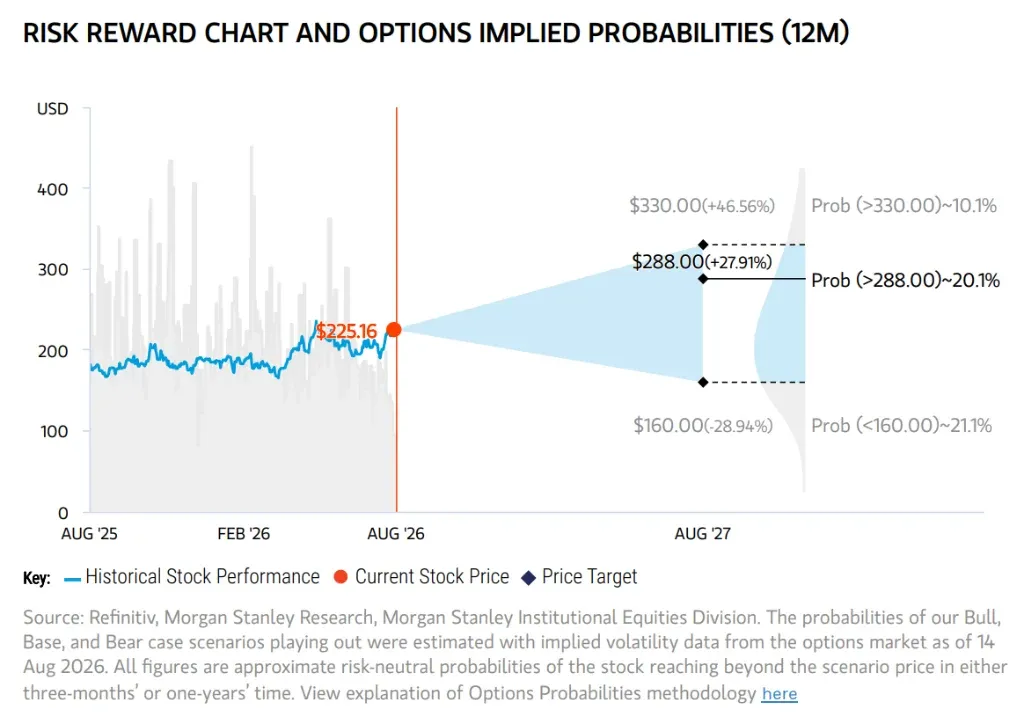
Nvidia’s challenge is not simply beating estimates but exceeding the expectations investors have formed beyond published consensus numbers.
The shares declined on the day after each of Nvidia’s last four earnings announcements, the first such four-quarter sequence since 2002, according to Dow Jones Market Data. Those reactions occurred even as the company continued delivering record revenue and profit.
The pattern suggests that a “beat and raise” result has shifted from a positive surprise to a minimum market requirement. Investors increasingly want evidence that Nvidia’s growth can remain elevated after Blackwell matures and competitors introduce more capable alternatives.
Recent signs of improving supply have also allowed traders to raise their informal expectations for the October quarter before the earnings release. Morgan Stanley consequently believes the largest potential upside may emerge in the January quarter, when Rubin revenue should become more significant.
Nvidia has confirmed that Rubin is in full production and that partner systems will become available during the second half of 2026. AWS, Google Cloud, Microsoft, Oracle, CoreWeave and other cloud providers are expected to deploy Rubin-based infrastructure. Nvidia describes Rubin as its next rack-scale platform for advanced reasoning, agentic AI and large-scale inference.
Morgan Stanley estimates that approximately 150,000 Rubin units could ship during the initial third-quarter ramp. At an estimated value of around $60,000 per unit, those shipments could contribute roughly $9 billion in revenue.
Testing partner KYEC recently lowered its annual outlook and shifted more AI-related revenue into late 2026 and 2027, raising concerns about possible Rubin delays. Morgan Stanley’s semiconductor analysts believe the change reflects longer testing schedules rather than weaker demand or reduced unit volumes.
The bank has therefore maintained its overall Rubin shipment assumptions while moving more testing activity from the third quarter into the fourth. Because its third-quarter volume forecast was already comparatively conservative, a modest delay would not necessarily alter Nvidia’s broader revenue trajectory.
Gross margin will be one of the most closely watched figures during the Nvidia earnings call. Morgan Stanley expects management to maintain its fiscal 2027 target in the mid-70% range.
The longer-term outlook is less certain. Rising costs for DRAM, advanced wafers, packaging and substrates could make it difficult for gross margin to recover as quickly as consensus forecasts suggest during fiscal 2028. Morgan Stanley currently projects gross margins of 74.4% for fiscal 2027 and 72.5% for fiscal 2028.
Investors are also evaluating Nvidia’s role in financing the infrastructure used to purchase its products. The company recently partnered with Apollo, BlackRock, Blackstone, Brookfield, Goldman Sachs and KKR to mobilize more than $500 billion of third-party capital for AI computing projects. The arrangement reduces Nvidia’s direct funding burden, but questions about circular financing and the quality of underlying demand remain part of the valuation debate. MarketWatch reported that analysts view the involvement of independent financial institutions as a partial answer to those concerns.
Competition presents another test. AMD continues expanding its accelerator and rack-scale product portfolio, while cloud providers are increasing their investment in custom ASICs. Nvidia will need to demonstrate that Rubin delivers enough performance and economic value to preserve the company’s dominant position.
Despite the near-term risks, Morgan Stanley remains optimistic about Nvidia’s longer-term financial performance. The bank forecasts fiscal 2027 revenue of approximately $393 billion and fiscal 2028 revenue of $598.8 billion, compared with a market consensus near $562.4 billion for fiscal 2028.
The bullish case rests on rising inference demand, the Rubin rollout and continued spending by frontier AI laboratories, enterprises and sovereign customers. Morgan Stanley also sees additional opportunities in networking, software, AI PCs and automotive systems.
That leaves Nvidia facing an unusually high hurdle on August 26. The company may once again surpass expectations and raise its outlook, yet investors could still demand clearer evidence that Rubin can sustain growth, margins can withstand rising input costs and Nvidia can protect its market leadership. For the stock, another excellent quarter may be necessary, but no longer sufficient.
Go Beyond Buying and Holding. Trade Global Stock Price Movements.
Markets.com gives you access to Stock CFDs across major global markets, with tools to help you analyze and manage your trades. Start trading today and unlock eligible new-client benefits.
Risk Warning: This article is provided for informational purposes only and does not constitute investment advice, investment research, or a recommendation to trade. The views expressed are those of the author and do not necessarily reflect the position of Markets.com. When considering shares, indices, forex (foreign exchange), and commodities for trading and price predictions, remember that trading CFDs involves a significant degree of risk and may not be suitable for all investors. Leveraged products can result in capital loss. Past performance is not indicative of future results. Before trading, ensure you fully understand the risks involved and consider your investment objectives and level of experience. Cryptocurrency CFD trading restrictions may apply depending on jurisdiction.
Latest
View all
Monday, 17 August 2026
7 min

Monday, 17 August 2026
7 min

Sunday, 16 August 2026
3 min

Monday, 17 August 2026
Indices
Gold Price Today, August 18, 2026: XAU/USD Rises Above $4,420 as Fed Hike Bets Fade

Monday, 17 August 2026
Indices
Bitcoin Price Today, August 18, 2026: BTC Slips 0.5% to $64,140 as Risk-Off Mood Returns

Monday, 17 August 2026
Indices
Sandisk Soars 8.88% and Micron Gains 4.13% as Memory Stocks Dominate US Turnover

Monday, 17 August 2026
Indices
Unitree Technology IPO Listing Date Set for August 19 as Robot AI Computing Demand Accelerates

Monday, 17 August 2026
Indices
Nvidia Earnings Preview: Morgan Stanley Sees $91.1 Billion Quarter, but Another Beat May Not Be Enough

Monday, 17 August 2026
Indices
Unitree Robotics IPO Set for August 19 as Retail Demand Tops 8,000 Times


 EN
EN





